
Seattle's Presentation Design Agency for Technology-Driven Business Leaders
As the presentation design firm in Seattle that technology companies, enterprise software leaders, aerospace organizations, and global retailers trust, StoryFlo understands an audience that thinks in systems, frameworks, and data, not emotions or generalities. Seattle's business culture was shaped by organizations that built the infrastructure of the modern internet, and audiences here evaluate presentations the same way they evaluate product architecture, for logical soundness, scalability of argument, and absence of gaps. StoryFlo builds presentations that survive the scrutiny of an audience that builds complex things for a living.

.avif)
![Backlit advertisement sign on a street displaying the word 'ASÍ' with its pronunciation and meaning: 'así (ah-see) adv. [Sp.] a. Like this, b. This way'. Below, text reads: 'CRE Retail Brokerage & Tenant Rep', set against a background of white arches and a corridor.](https://cdn.prod.website-files.com/6a1423bf64953b6741b4dff8/6a50ee682905177218b4e3e3_Header%20Image%2002.avif)










Professional Presentation Design Services Seattle
Seattle's decision-makers, engineering leaders, product executives, enterprise procurement teams, and global operations directors, evaluate presentations the way they evaluate proposals and system designs. They look for internal consistency, evidence quality, and logical completeness. Companies that hire presentation designers Seattle trusts get work built to pass exactly that evaluation.
Enterprise Product Launches
Enterprise software and technology product launches, internal launch briefings, partner ecosystem announcements, and customer introduction decks must communicate product architecture, business value, and adoption roadmap simultaneously. In Seattle's product-driven culture, audiences immediately test every claim against their own technical knowledge.
Cloud Platform Pitches
Cloud infrastructure, platform-as-a-service, and enterprise SaaS pitches to Fortune 500 procurement and technology leadership require a precise balance: technical depth for IT decision-makers and business case clarity for financial and operational executives sharing the same evaluation table.
Aerospace Program Reviews
Aerospace and defense program reviews, milestone briefings, contract performance reviews, and new program proposals, must satisfy engineering rigor and program management structure simultaneously, with every technical claim supported by schedule and budget data.
Global Retail Strategy
Global retail and e-commerce presentations, supplier partnership decks, omnichannel strategy, and international market entry briefings must translate supply chain, logistics, and consumer behavior data into a strategic narrative leadership can act on across multiple markets at once.
Clean Energy Investment
Clean energy, climate technology, and sustainability investment decks operating in the Pacific Northwest must bridge environmental impact metrics and financial return frameworks, two languages that occupy very different cognitive registers for the mixed audiences these presentations typically face.
Executive Alignment Sessions
Annual planning sessions, cross-functional strategy alignment, and organizational priority-setting meetings align large, distributed executive teams behind a single direction. In Seattle's large-enterprise environment spanning multiple time zones and divisions, this requires shared understanding built in a single session.
How We Build Arguments
Objective and Constraint Definition
Argument Structure Build
Design System Execution
Output Validation Check




Define Your Objective. We Will Build the System.
Every StoryFlo engagement begins with a precise definition of what the presentation needs to achieve and who it needs to achieve it with. Our presentation design agency Seattle teams work with responds within one business day with a proposed engagement structure.
Get in Touch
Tell us your audience, your objective, and your deadline. We will come back with a structured approach.
Engagements That Produced Verifiable Results
Each case study below represents a completed StoryFlo engagement with a specific, client-confirmed outcome attached. The audiences in these rooms were experienced, technical, and skeptical. The presentations had to hold up under direct examination.
.avif)
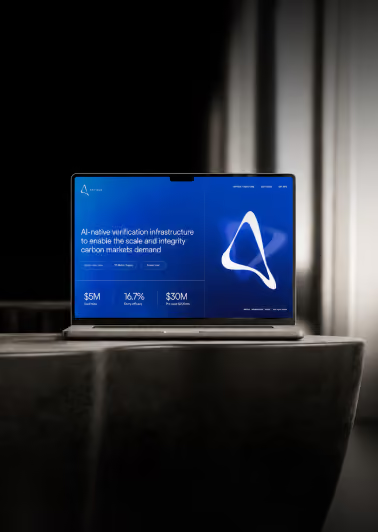
Enterprise Software Company Closes $340M Multi-Year Government Contract
A Seattle enterprise software company was competing for a multi-year federal technology contract. Their proposal was structured like a technical specification, exhaustive in detail, invisible in strategy, against three competitors presenting the same capability set. StoryFlo rebuilt the presentation around mission outcome alignment, leading with the agency's objective and showing how the platform delivered against each metric. The contract was awarded at full value with no negotiation on scope.
.avif)
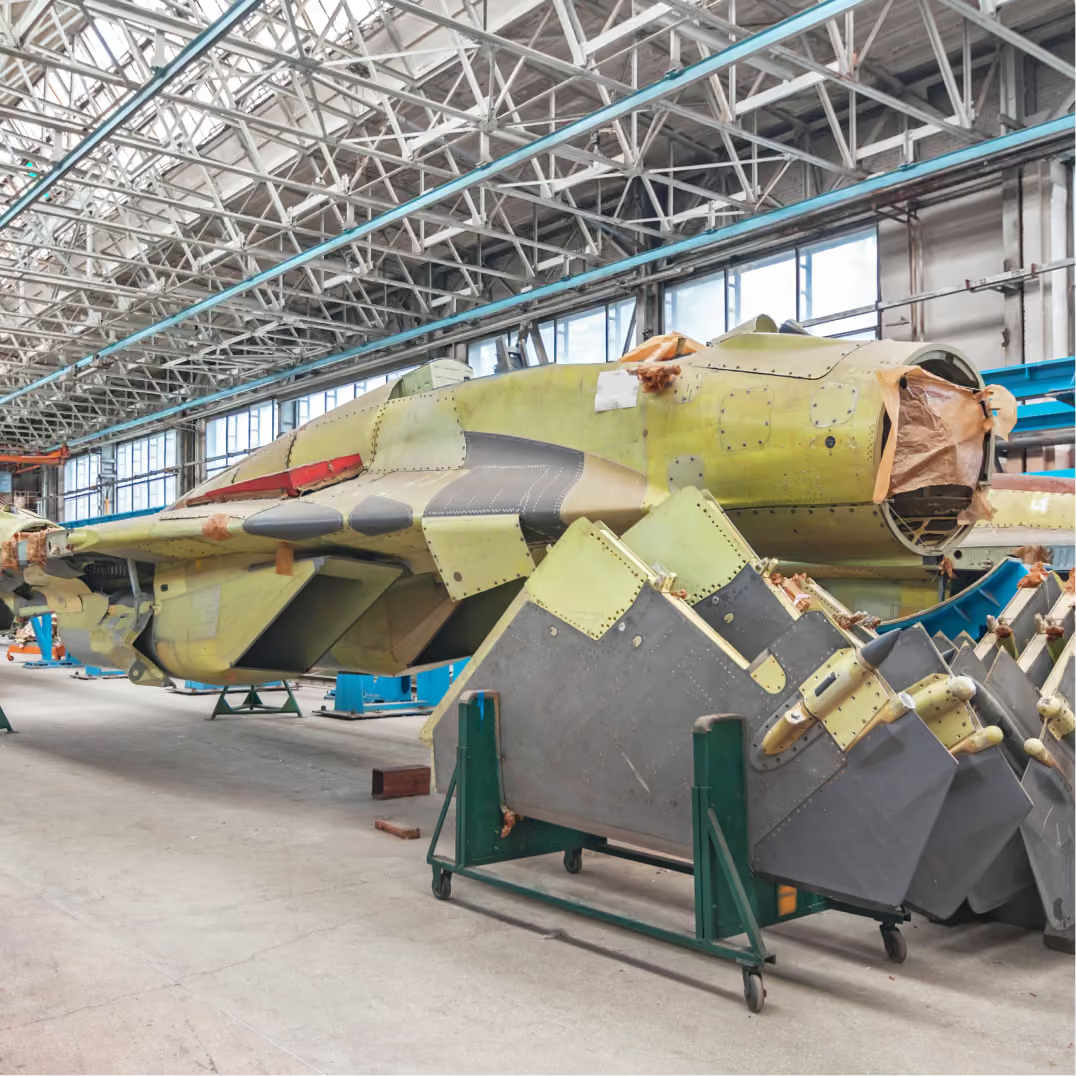
Aerospace Manufacturer Wins Program Extension Worth $180M in First Review
A Pacific Northwest aerospace manufacturer was presenting a program performance review to a government customer with an extension decision in the balance. The existing format was a data dump of schedule and budget tables with no narrative connecting performance to future capability. StoryFlo rebuilt it as a structured performance narrative: achievement against milestone first, variance explanation second, forward plan third. The program extension was approved at full value on the first review.
Value Retained
.avif)
Clean Energy Platform Raises $95M Growth Round from Infrastructure Investors
A Seattle-area clean energy technology company was raising growth capital from infrastructure-focused investors, a different audience than the typical venture investor. Their existing deck was built for climate-focused VC audiences and led with environmental impact metrics, but infrastructure investors needed financial return architecture first. StoryFlo rebuilt the deck with a complete audience pivot: infrastructure return model first, technology validation second, ESG impact third. The growth round closed at $95M with an infrastructure-focused lead investor.
Outcomes Our Clients Measured
Direct feedback from Seattle technology, aerospace, and enterprise organizations. Each testimonial reflects a quantified outcome from a presentation that faced technical scrutiny.

We'd lost this exact federal contract in the previous bidding cycle. StoryFlo rebuilt our procurement presentation around the agency's mission outcomes instead of our feature list. We won the $340M contract at full scope, no negotiation required.
Our technical and financial buyers were getting two different pitches from two different meetings. StoryFlo built one presentation that satisfied both in the same room. Our enterprise sales cycle dropped by six weeks on average.
Our contract modification had been stalled for months because the customer's program office couldn't follow our performance narrative. StoryFlo restructured the review around milestone achievement first. The modification was approved at our next review.
We'd been locked out of infrastructure capital because our deck was built for climate VCs, not infrastructure investors. StoryFlo rebuilt it around financial return architecture. We closed our growth round with an investor category we couldn't access before.
Our international expansion proposal had been declined twice in two years. StoryFlo rebuilt the market entry case around a clearer strategic narrative. The board approved the expansion on the next presentation.
Our annual planning session hadn't moved the alignment needle in four years. StoryFlo redesigned the presentation for our distributed executive team. Our post-session alignment scores improved for the first time in four years.
Our technical and financial buyers were getting two different pitches from two different meetings. StoryFlo built one presentation that satisfied both in the same room. Our enterprise sales cycle dropped by six weeks on average.
Seattle's Industries We Know Deeply
Sector knowledge in Seattle means understanding how engineering, product, and business leadership think simultaneously about the same problem. Our presentation design solutions Seattle organizations rely on are built to work for all three at once.








Why Seattle's Enterprise Culture Sets the Highest Presentation Bar
Presenting to People Who Build Products for a Living
Seattle's senior leadership population includes a uniquely high concentration of people who spent significant parts of their careers building products, writing code, designing systems, or engineering physical things. When these people sit in a presentation, they evaluate it with a product manager's eye. They look for the user story, the acceptance criteria, and the edge cases the argument has not addressed.
The Common Failure Mode
The most common failure in Seattle presentations comes from decks built by marketing or communications teams that prioritize narrative flow over logical completeness. Engineering and product leaders notice immediately when an argument skips a step or when a conclusion does not actually follow from the evidence presented, and once they notice, the rest of the deck loses credibility fast.
Harder Questions, Faster
Seattle audiences ask harder questions than most. The Q&A after a presentation in a Seattle boardroom or product review session will surface logical gaps, missing data, and unstated assumptions faster than in most other business environments. A presentation built without anticipating this scrutiny rarely survives the first round of follow-up questions intact.
Building the Q&A Into the Architecture
This requires a different approach to argument construction, one where every slide is evaluated not just for what it communicates but for what questions it will generate in the room. StoryFlo builds the anticipated Q&A into the presentation architecture from the start, rather than treating it as an afterthought handled with improvised answers.
Why the Appendix Matters More Here
The backup appendix for a Seattle presentation is often more important than the main deck, because the audience will go there, and what they find determines whether they leave the room as believers or skeptics. The presentation design agency Seattle technology and enterprise companies need is not one that makes slides look impressive. It is one that makes arguments hold up under examination by people who build complex things for a living.

The Difference Between Clarity and Simplicity in Technical Presentations
Simplicity strips out complexity. Clarity makes complexity understandable. These are not the same thing, and confusing them is one of the most common and most damaging errors in technical presentation design. A deck can be simple and still fail to communicate anything the audience actually trusts.
What Seattle Audiences Actually Want
Seattle's technical audiences do not want simplicity. They want clarity. They need to see the complexity, the system architecture, the data model, the program schedule, but they need it presented so the relationships between components are immediately visible rather than buried inside dense paragraphs or oversized tables.
Why Over-Simplification Fails
The over-simplified presentation, where complex technical content gets reduced to three bullet points, fails in Seattle because the audience knows what has been left out and loses confidence in the presenter's command of the subject matter. Stripping detail to look clean often reads as evasion rather than efficiency.
Why Over-Complexity Fails Too
The over-complex presentation, where every detail has been included with no visual hierarchy, also fails because it requires the audience to do the synthesis work themselves, which they will not do under time pressure. Both failure modes leave the room with less confidence than when they walked in.
The Three-Layer Solution
StoryFlo navigates this with a three-layer architecture: the main slide carries the synthesized insight, the visual carries the supporting structure, and the backup slide carries the technical detail for the audience member who needs to go deeper. This satisfies both the executive who needs the insight and the engineer who needs the proof. Working with a presentation design company Seattle organizations in technical industries choose means working with a team that understands this distinction and builds every layer with it in mind.

Building Presentations That Work for Engineering, Product, and Business Simultaneously
In most business markets, presentations are built for one primary audience type. In Seattle's large enterprise environment, a single presentation commonly needs to work for a VP of Engineering, a Chief Product Officer, and a CFO who are all sitting in the same room, evaluating the same slides through three completely different professional frameworks.
Three Different Definitions of a Good Answer
The VP of Engineering evaluates technical feasibility and implementation risk. The CPO evaluates product market fit and user impact. The CFO evaluates financial return and capital efficiency. A presentation built to satisfy one of these three typically frustrates the other two, and most presentations only realize this after the meeting has already gone sideways.
The StoryFlo Sequencing Approach
StoryFlo's approach to multi-framework presentations opens by establishing shared context all three frameworks accept, then rotates through the middle sections to deliver the specific evidence each framework needs in sequence, before closing with a synthesis across all three into a single recommendation none of them can reasonably reject.
Creative Architecture, Not Creative Decoration
Creative presentation design Seattle-style means creative in architecture, finding the sequencing solution that moves three different professional mindsets toward one decision without making any of them feel like their concerns were ignored along the way. That is a structural problem, not a visual one.
Stakeholder Mapping From the Start
This is why the strategy session at the start of a StoryFlo engagement includes a stakeholder mapping exercise, identifying every audience member's professional background, their likely primary concern, and the specific evidence that will satisfy their framework before a single slide gets designed. When Seattle organizations need custom business presentation design Seattle rooms like this require, StoryFlo's process is built specifically to handle that complexity.

Engagement Structures Designed for Your Presentation Scope
Every engagement is scoped against your audience profile, argument complexity, and delivery timeline before work begins. Select the engagement structure that matches the scope of what your presentation needs to achieve.
Frequently Asked Questions
Enterprise buyers, founders, and senior executives will find immediate answers about StoryFlo's presentation design process, engagement model, and delivery standards here.
Yes. Our presentation design agency in Seattle maps the agency's stated evaluation criteria before building the argument structure, ensuring the presentation addresses every scoring dimension the procurement team is using, not just the capabilities the vendor wants to highlight.
We use a multi-stakeholder sequencing approach, designing the architecture to satisfy each audience type at a specific point in the narrative rather than trying to satisfy everyone with every slide. Our three-layer structure puts synthesized insight at the heading level, supporting structure in the visual, and technical detail in the appendix.
Yes. We build system architecture diagrams, process flow visuals, data model representations, program timeline charts, and technical comparison frameworks. Every technical visual is built from your source documentation and reviewed for accuracy before inclusion in the final deck. This is a core capability, not an add-on service.
Yes. StoryFlo works within your security protocols for export-controlled and sensitive program content, and engagements can be structured to work within your IT environment and document handling requirements. Clients with classified or ITAR-controlled content should discuss specific requirements during the initial strategy call before engagement begins.
We build a modular architecture: a core narrative that stays consistent, with interchangeable sections your team can customize per prospect, per vertical, or per deal stage without rebuilding the entire deck. The modular system includes a configuration guide so your sales team can assemble the right version independently.
Clean energy presentations commonly face two audiences at once: impact-focused stakeholders evaluating environmental metrics and financial stakeholders evaluating return and risk. Our presentation design solutions Seattle clean energy companies use establish financial return first, then integrate impact evidence as risk reduction and differentiation, not as a standalone argument.
Your Audience Builds Complex Systems. Your Presentation Should Match That Standard.
The people in these rooms build products and systems that power global organizations, and they evaluate presentations with the same rigor they apply to architecture reviews and product decisions. A presentation that cannot hold up under that examination will not earn the outcome. StoryFlo is the presentation design agency Seattle enterprise and technology leaders trust to meet that standard.