
Washington DC's Presentation Design Agency for Consequential Decisions
Washington DC's most consequential organizations don't hire a presentation design firm in Washington DC to win over a single buyer. Federal contractors, defense organizations, development agencies, policy advocates, and diplomatic institutions trust StoryFlo when a decision carries public consequence, not commercial outcome. DC's audiences aren't evaluating whether to spend capital, but whether to allocate authority, award contracts, or set policy direction. The argument must be airtight, defensible under scrutiny, and matched to the evaluator's framework. StoryFlo builds presentations calibrated to Washington's most consequential rooms.

.avif)
![Backlit advertisement sign on a street displaying the word 'ASÍ' with its pronunciation and meaning: 'así (ah-see) adv. [Sp.] a. Like this, b. This way'. Below, text reads: 'CRE Retail Brokerage & Tenant Rep', set against a background of white arches and a corridor.](https://cdn.prod.website-files.com/6a1423bf64953b6741b4dff8/6a50ee682905177218b4e3e3_Header%20Image%2002.avif)










Professional Presentation Design Services Washington DC
Hire presentation designers Washington DC organizations rely on to understand one thing: this market runs on institutional authority, not purchasing authority. When the decision-maker controls policy, legislation, contract awards, or public resources, the presentation must follow different rules than a commercial pitch. Every service below is built around that reality.
Federal Proposal Decks
Presentations built to support federal contract proposals, including oral presentation components of government RFP responses, technical evaluation briefings, and best-and-final-offer presentations. These must align precisely to the government's stated evaluation factors, in the exact sequence the evaluation panel will use to score responses.
Congressional Briefing Decks
Presentations for organizations briefing congressional offices, committees, and caucuses, including policy advocacy presentations, legislative priority briefings, and constituent impact presentations. These briefings operate under severe time constraints and must communicate complex policy positions to generalist legislative staff managing dozens of competing issue areas.
Defense Intelligence Briefings
Presentations for defense contractors and intelligence community organizations, including program status briefings, capability demonstrations, and strategic initiative presentations to senior government officials. These operate under security classification requirements and must communicate sensitive program information within strict handling protocols while making a compelling case.
International Development Decks
Presentations for USAID implementers, World Bank project teams, United Nations agencies, and international NGOs presenting program designs, results frameworks, and funding proposals to multilateral donors. These must satisfy technical program evaluation standards and political constituency considerations at once, a dual-audience challenge unique to multilateral decision-making.
Think Tank Presentations
Presentations for policy research organizations, think tanks, and advocacy groups launching research findings, policy recommendations, and public reports. These must establish research credibility, translate complex policy analysis into accessible public language, and create a clear policy prescription, all while meeting rigorous citation and methodology standards.
Diplomatic and Embassy Decks
Presentations for foreign government embassies, diplomatic missions, and bilateral trade and investment organizations operating in Washington DC. These must navigate cultural communication norms, protocol requirements, and the persuasion conventions of international institutional audiences while achieving a concrete policy or commercial objective with American counterparts.
Built for Institutional Scrutiny
Evaluation Criteria Mapping
Evidence and Compliance Review
Structured Visual Development
Institutional Review Preparation




Share Your Evaluation Context. We Will Build the Case.
StoryFlo begins every DC engagement by understanding the evaluation framework: who is reviewing the presentation, what criteria they're using, and what the formal process looks like from submission to decision. As a presentation design agency Washington DC institutions rely on, we respond within one business day with a proposed approach aligned to your specific institutional context.
Get in Touch
Tell us about your reviewing institution, your evaluation timeline, and your objective. We will respond with a structured plan.
Institutional Outcomes from Completed Engagements
Every result below reflects a completed StoryFlo engagement where the outcome was determined by an institutional evaluation process, not a single decision-maker's preference. These presentations were reviewed by evaluation panels, congressional committees, and multilateral donor bodies operating under formal assessment criteria.
.avif)
Federal IT Contractor Wins $275M IDIQ Contract in Competitive Oral Presentation
A DC-area federal IT contractor was competing for a major IDIQ contract requiring an oral presentation. Their written proposal was strong, but their oral approach, like three of four competitors, was simply reading from slides. StoryFlo rebuilt the presentation as a structured institutional argument, following the government's scoring sequence factor by factor. The contract was awarded at full ceiling value.
.avif)
International Development Organization Secures $48M USAID Cooperative Agreement
A DC-based international development organization was competing for a major USAID cooperative agreement. Their technical presentation covered all required elements but followed the organization's preferred narrative order rather than USAID's evaluation sequence. Reviewers noted extra effort was needed to locate specific elements. StoryFlo rebuilt the presentation to mirror USAID's framework exactly, with headers matching each evaluation factor. The agreement was awarded at full value on recompete.
.avif)
Defense Contractor Recovers Stalled Program After Single Executive Briefing
A defense contractor's major program was flagged for potential cancellation due to unexplained schedule and cost variances. Prior briefings were data-accurate but narrative-absent. Tables with no thread linking causes to corrective actions to future confidence. StoryFlo rebuilt the briefing as a recovery narrative: variance context, corrective actions, then forward confidence evidence. The cancellation flag was removed immediately.
DC Organizations Share Their Results
Direct feedback from federal contractors, policy organizations, and DC institutions. Each testimonial reflects a specific outcome from a presentation evaluated by an institutional review process.

StoryFlo rebuilt our oral presentation to align with the government's evaluation factors instead of our own narrative preferences. We had lost this same recompete two cycles in a row. This time, on a contract with a ceiling value north of $200M, we won. The structure alone changed the outcome, our content barely changed at all.
Our previous research report launches generated minimal external engagement outside our own network. StoryFlo rebuilt our launch presentation to serve media, congressional staff, and policy practitioners all at once, in one core deck. Within 30 days of publication we had coverage from four national outlets and three requests for congressional testimony, a result we had never come close to before.
Our program review briefings were accurate but tense, full of numbers with no explanation behind them, and our customer relationship had gone cold as a result. StoryFlo rebuilt the briefing as a recovery narrative rather than a data dump. The program office requested a follow-up collaboration session within two weeks, the first proactive outreach from them in fourteen months.
Our LP update presentations needed to communicate fund performance transparently during a difficult market cycle where institutional investors were actively scrutinizing allocation decisions. StoryFlo structured the narrative around LP confidence signals: data transparency, risk acknowledgment, and forward thesis discipline. We closed that cycle with zero LP withdrawals.
Our legislative priority briefing had generated no committee movement for three years running. StoryFlo rebuilt it around what congressional staff actually need in order to evaluate an ask quickly. We used the new version in 47 congressional office meetings in a single advocacy day, and our priority advanced out of committee for the first time in three years.
We had lost this exact USAID mechanism two years earlier on a similar proposal. StoryFlo rebuilt our technical presentation to mirror the published evaluation framework precisely, section by section, factor by factor. We received the highest technical score among all competing offerors and were awarded the program, with me serving as Chief of Party designate for the implementing team.
We'd been rejected for this grant once already. StoryFlo rebuilt the presentation around the foundation's actual priorities instead of ours. We received the full grant amount on the second submission.
DC Sectors Where We Deliver
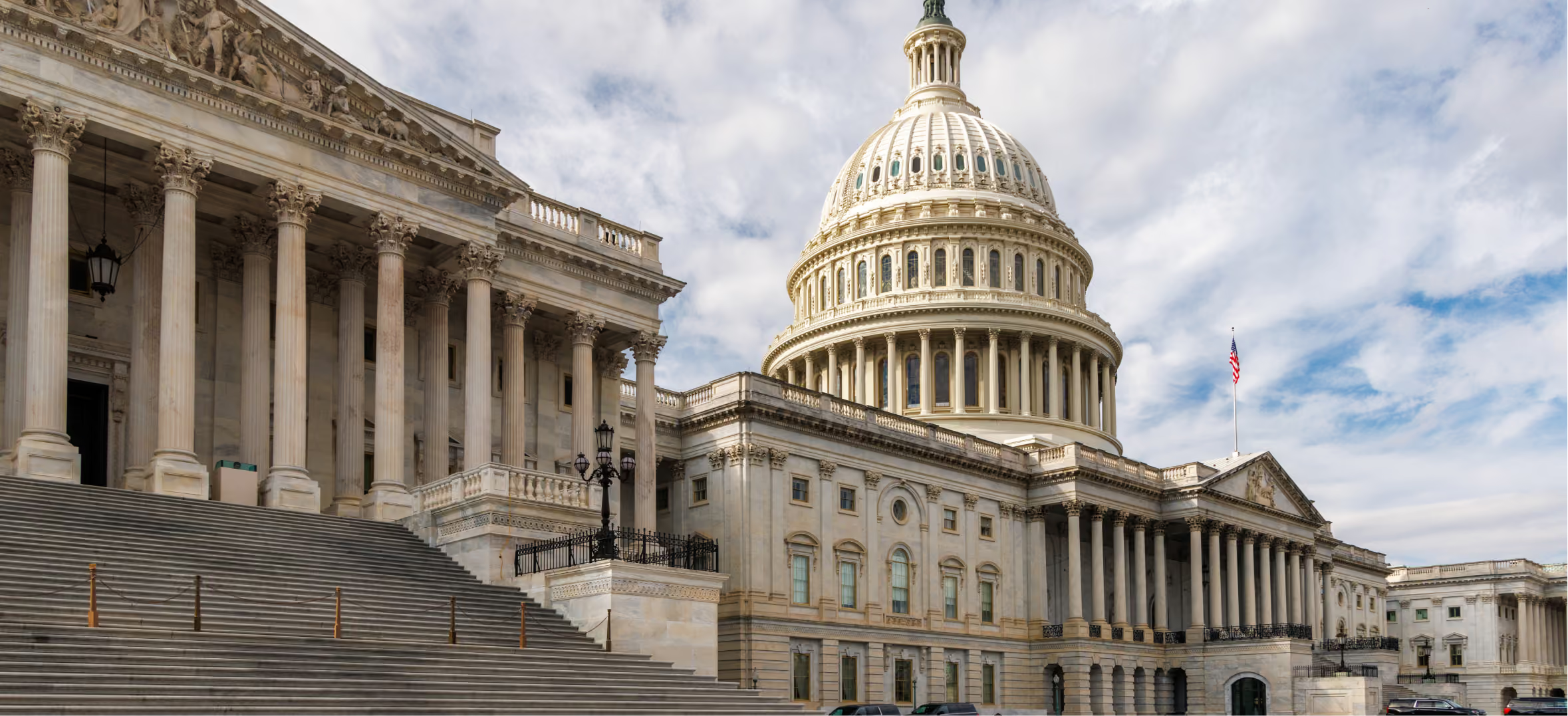
The sectors below represent Washington DC's institutional economy, where presentation design solutions Washington DC organizations need are evaluated by formal review, not purchase decisions. Each sector carries its own standards and decision-making hierarchy that StoryFlo builds around.








What Makes Washington DC Presentations Categorically Different to Build
When the Decision-Maker Has Institutional Authority, Not Purchasing Authority
In every other US business market, the ultimate decision-maker in a presentation is a buyer, someone who controls a budget and decides how to spend it. Commercial, financial, and strategic authority are unified in one person or committee, and the presentation is designed to persuade that buyer.
In Washington DC, the decision-maker structure is fundamentally different. A federal contracting officer applies FAR-compliant evaluation criteria that constrain how they can make the award decision; personal preference is explicitly subordinated to the evaluation framework. A congressional committee chair advances legislation based on member consensus, constituent impact, and political feasibility, not a single person's judgment. A multilateral donor panel scores proposals against published evaluation criteria that all reviewers must apply consistently.
This shows up in practice in ways that surprise organizations arriving in DC from other markets. A strong opening story that opens doors with a commercial buyer can read as filler to a federal evaluator working through a checklist. A confident, charismatic delivery can work against a presenter in a room where the panel scores content against fixed criteria, not personal impression. The instinct to lead with the strongest point, a staple of commercial pitching, often buries the answer an evaluator is scanning for.
For presentation design, this means the presentation isn't built to persuade a person, it's built to align with a process. A presentation built to persuade will actively fail in an institutional evaluation context because it optimizes for the wrong objective.
Aligning with a process requires a different architecture: the presentation must mirror the evaluation framework's structure, address each scoring criterion in sequence, and make the evaluator's job of locating the answer to each criterion as easy as possible. Every slide functions as a scored response, and every section heading should map back to a specific line in the framework the audience is using.
StoryFlo's approach to DC presentations begins with the evaluation framework, not the client's message. The client's story is told through the evaluator's framework, not alongside it. This is why organizations looking for a presentation design agency Washington DC institutions and contractors trust need a team that understands institutional process design, not just narrative design.

The Compliance Layer That DC Presentations Must Navigate
Federal acquisition regulations govern how contractors can communicate with government evaluators during a procurement. Strict rules define what can be said, when, and through what channels, down to which staff members may speak with a given evaluator during a live procurement window. A presentation that inadvertently violates these communication standards can result in a proposal disqualification, regardless of the technical quality of the content itself, and regardless of how strong the underlying program design might be.
Congressional ethics rules constrain how organizations can present information to elected officials and their staff. Lobbying disclosure requirements, gift rules, and ex parte communication restrictions all affect what kind of presentation is appropriate in which context, who within an organization is even permitted to deliver it, and what materials can be left behind after a meeting concludes.
USAID and other foreign assistance agencies require presentations and proposals to adhere to specific data quality standards, M&E framework requirements, and results reporting conventions established well before any single proposal is submitted, standards that donor agencies routinely audit long after an award is made. A presentation that doesn't conform to these standards signals institutional inexperience that disqualifies organizations regardless of program design quality, even when the underlying program itself is genuinely strong.
These compliance layers aren't bureaucratic obstacles, they're communication standards that define what a credible DC institutional presentation looks like. Organizations that navigate them correctly signal institutional credibility before a single slide is scored on its merits. Organizations that ignore them signal inexperience, which is disqualifying in DC's trust-based institutional culture, sometimes before the content itself is ever evaluated.
StoryFlo's DC engagement process includes a compliance review phase where the presentation's content, structure, and delivery channel are evaluated against the specific regulatory and ethical framework governing the audience relationship. This review happens before the visual design phase, not as an afterthought, because a compliance issue found late is far more costly to fix than one caught early. Working with a presentation design company Washington DC organizations in regulated institutional contexts need means working with a team that treats compliance as a core component of the communication architecture, not a constraint on creativity.

Translating Policy Complexity Into Presentations That Drive Legislative and Institutional Action
Policy complexity is different from technical complexity. A biotech company translates scientific data into investor language, a translation between two domains with shared interest in the outcome. A DC policy organization translates research findings into legislative action, a translation between the evidence domain and the political feasibility domain, which often have directly competing interests and entirely different definitions of a successful outcome.
The policy presentation failure mode is presenting research conclusions as if logical sufficiency alone produces legislative action. It doesn't. A congressional staffer reviewing a policy brief is evaluating three things at once: is the evidence credible, is the policy ask politically feasible for my member, and does this align with the committee's current legislative calendar. A presentation that answers only the first question, no matter how rigorous the research behind it, fails at the institutional level regardless of research quality, and regardless of how much the presenter believes the evidence should speak for itself. Evaluators are trained to notice when a presentation moves straight to advocacy without first demonstrating it understands the political terrain it is asking them to navigate.
This is where creative presentation design Washington DC organizations need becomes essential, creative in how the policy argument is sequenced to address all three evaluation dimensions at once. Leading with constituency impact data signals political feasibility, building through research evidence signals credibility, and closing with a specific, narrow legislative ask signals calendar compatibility. Together they create a structure that works across all three dimensions simultaneously, rather than optimizing for evidence alone and hoping political feasibility and timing take care of themselves.
This sequencing is counterintuitive for researchers and policy experts who naturally lead with the evidence, since that is how their own professional training taught them to argue and to be taken seriously by peers. But in DC's institutional communication culture, the political feasibility of the ask must be established before the audience will invest attention in the evidence supporting it. When DC organizations need custom business presentation design Washington DC built for the specific complexity of policy communication, StoryFlo's methodology is built around institutional persuasion architecture, not commercial narrative design.

Engagement Tiers Calibrated to Your Institutional Context
Every engagement begins with a review of the institutional evaluation framework governing your presentation before any content or design work begins. Select the engagement depth that matches the formality and complexity of the institutional process your presentation must navigate.
Frequently Asked Questions
Enterprise buyers, founders, and senior executives will find immediate answers about StoryFlo's presentation design process, engagement model, and delivery standards here.
The presentation architecture mirrors the government's evaluation factor structure, with each section of the oral presentation corresponding to a scored evaluation factor in the sequence the evaluation panel will use. As a presentation design agency Washington DC contractors trust, StoryFlo maps the evaluation factors before building a single slide, and every content decision is made against one question: does this help the evaluator score this factor favorably?
Yes. USAID and World Bank proposal presentations require alignment to published evaluation criteria, results framework conventions, and donor-specific terminology standards. StoryFlo reviews the solicitation or funding opportunity announcement before building the presentation architecture, so every required element is addressed in the evaluator's preferred sequence and language.
Yes. Research launch presentations serve multiple simultaneous audiences, media, congressional staff, and policy practitioners, each of whom needs a different angle on the same research. StoryFlo builds a core presentation that serves all three audiences, along with a modular adaptation system for audience-specific versions used in different meeting contexts.
StoryFlo works within the client's established security protocols for sensitive and classified program content. For unclassified presentations in the defense and intelligence community context, StoryFlo coordinates with the client's security officer to ensure content handling, file transfer, and storage procedures meet the program's specific requirements before engagement begins.
Yes. Congressional advocacy presentations require a different structure than single-meeting briefings, since they must be deliverable consistently by multiple advocates in rapid succession across dozens of congressional office meetings in a single day. StoryFlo builds advocacy presentations with a tight core message, a leave-behind format, and a consistent visual system non-professional presenters can deliver without prior training.
Embassy and diplomatic mission presentations must navigate cultural communication norms, protocol requirements, and the persuasion conventions of the presenting nation's institutional culture, while meeting the expectations of the American audience receiving the presentation. As part of presentation design solutions Washington DC diplomatic clients rely on, StoryFlo conducts a bilateral communication audit at the start of engagement to resolve cultural misalignments before they enter the room.
The Institution Evaluating Your Presentation Has Already Decided What It Is Looking For.
Every formal evaluation process, federal procurement, congressional review, donor assessment, or diplomatic protocol has a defined framework before the presentation enters the room. Organizations that succeed build to match that framework. Those that fail present a strong message in the wrong structure. As the presentation design agency Washington DC trusts, StoryFlo builds for the framework.