
Earn Clinical Confidence with HealthTech Presentation Design Agency
StoryFlo is the HealthTech presentation design agency that digital health platforms, remote patient monitoring companies, clinical decision support vendors, EHR companies, population health platforms, and telehealth providers trust to earn clinical confidence from audiences evaluating patient safety, not commercial convenience. HealthTech asks hospital boards to trust patient safety implications no commercial software buyer ever weighs. From HealthTech startup presentation design at formation through enterprise health system partnerships, StoryFlo builds decks where clinical evidence and regulatory clarity reinforce the commercial case instead of undermining it.

.avif)
![Backlit advertisement sign on a street displaying the word 'ASÍ' with its pronunciation and meaning: 'así (ah-see) adv. [Sp.] a. Like this, b. This way'. Below, text reads: 'CRE Retail Brokerage & Tenant Rep', set against a background of white arches and a corridor.](https://cdn.prod.website-files.com/6a1423bf64953b6741b4dff8/6a50ee682905177218b4e3e3_Header%20Image%2002.avif)












Professional HealthTech Presentation Design Services
HealthTech is the only technology sector where a presentation that overstates clinical capability or understates implementation risk can create direct patient safety liability. Health system audiences apply a clinical risk framework to every presentation. HealthTech companies that hire HealthTech presentation designers get a team built to that exact precision standard.
HealthTech Investor Presentations
Investor decks for seed-stage digital health startups through growth-stage platforms raising from health tech funds and generalist investors who need the FDA pathway explained in risk terms they can evaluate. The regulatory pathway directly determines timeline, reimbursement, and market entry, and we build it as the strategy foundation, not a compliance footnote.
Health System Sales Decks
Enterprise sales presentations for hospital systems and IDNs face the most complex stakeholder structure in technology: clinical committees evaluate patient safety, IT evaluates EHR integration, revenue cycle evaluates reimbursement, legal evaluates HIPAA exposure, and physician champions evaluate workflow fit. Missing any one dimension stalls the deal indefinitely.
FDA Regulatory Strategy Decks
Presentations explaining 510(k), De Novo, or PMA pathway strategy to investors and board members, translating regulatory science into business strategy language for audiences accountable for commercial outcomes but lacking regulatory training. We position the FDA pathway as a confidence signal, not a risk flag.
Value-Based Care Pitches
Presentations for risk-sharing arrangements and population health agreements must speak two financial languages simultaneously. The clinical outcome metrics health systems track and the ROI language CFOs and payers require, without oversimplifying the clinical model or burying the financial argument.
Clinical Evidence Communications
Presentations translating peer-reviewed studies, real-world evidence, and registry data into commercial value arguments require dual-literacy architecture, methodology rigor physician reviewers require, and commercial implications precise enough for non-clinical audiences to evaluate independently alongside them.
Patient Safety Accountability Decks
Incident response communications, safety monitoring frameworks, and post-market surveillance reports carry the highest precision requirement in any technology category. Every claim must be clinically accurate, every limitation stated, every corrective action operationally specific, because overstatement here creates direct liability exposure.
Clinical Precision Before Commercial Clarity
Clinical Evidence Validation
Regulatory Pathway Translation
Commercial Value Architecture
Implementation Risk Transparency




Bring Your Clinical Evidence. We Will Build the Case That Moves Health Systems.
Every engagement begins with a full clinical evidence audit and regulatory pathway review, mapping every proof asset before building the presentation architecture around it. Our HealthTech presentation design agency, StoryFlo, responds within one business day with a proposed clinical evidence approach built around your regulatory status and target health system audience.
Get in Touch
Tell us your regulatory status, your clinical evidence profile, and the health system decision process you are navigating. We will build from there.
HealthTech Presentations That Cleared Clinical Committees
Every result below reflects a completed engagement where a HealthTech organization needed to clear the clinical committee, earn physician champion support, or convert a complex health system evaluation into a signed agreement. These presentations were reviewed by CMOs, clinical informatics committees, physician governance bodies, and healthcare investors who evaluate patient safety implications before commercial value.
.avif)
Remote Patient Monitoring Platform Wins $38M IDN Contract After Clinical Evidence Architecture Rebuild
A remote patient monitoring company had been stalled nine months in an IDN's evaluation. Their prospective study across 400 CHF patients showed a 34% readmission reduction, but the sales presentation was built as a product demo focused on device features. The clinical committee had reviewed it twice, requesting more clinical impact evidence each time. StoryFlo rebuilt the presentation to open with the study methodology and outcomes in clinical review format, introducing features only as the mechanism behind the results. Contract awarded at $38M.
.avif)
Digital Health Startup Closes $23M Series B After FDA Regulatory Pathway Made Investment Case
A clinical decision support company had spent six months in Series B talks without closing. Their FDA 510(k) clearance, a genuine competitive moat no rival had achieved, sat in a single bullet point near the back of the deck. Investors asking about it in Q&A were impressed, but it had never been positioned as the primary differentiator it was. StoryFlo rebuilt the deck to open with the clearance as the business strategy foundation. Series B closed at $23M.
.avif)
Population Health Platform Wins Value-Based Care Contract Worth $15M Annual Revenue
A population health platform pursuing an ACO partnership led its presentation with technical capabilities, while the health system's CFO and CMO needed a financial model showing HEDIS improvement and total cost of care reduction under their specific shared savings arrangement. StoryFlo rebuilt the presentation to open with the value-based care financial model, translating every clinical capability into projected ACO impact. Contract signed at $15M annual revenue with both executives aligned in the first meeting.
HealthTech Leaders. Clinical Confidence.
Feedback from HealthTech founders, clinical affairs leaders, and health system sales teams. Each testimonial reflects a specific clinical confidence outcome, a health system that evaluated the evidence and advanced, or an investor who understood the regulatory pathway and committed.

The clinical committee chair told us directly that our methodology presentation was what separated us from the four competing RPM platforms under evaluation. We had been stalled for nine months with the same clinical evidence sitting unused in a folder nobody had touched. StoryFlo rebuilt the deck to lead with the study data instead of the product demo, and we closed at $38M.
Our lead investor told us afterward that the regulatory strategy section was the exact moment their evaluation shifted from cautious to confident. We had our FDA 510(k) clearance sitting in a single bullet point for six months of fundraising that went nowhere. StoryFlo moved it to the front of the deck, and we closed our Series B within weeks.
We had generated technical interest for months but no commercial commitment from anyone with budget authority. StoryFlo rebuilt our pitch around the ACO financial model instead of our product features, and our CFO and CMO aligned in the same room for the very first time. We signed the value-based care contract at that meeting.
Our legal team genuinely expected contract termination after an adverse event involving our platform. The health system's CMO specifically credited the clinical precision and corrective action detail in StoryFlo's presentation with keeping the partnership intact. That presentation was the difference between losing a major account and maintaining a relationship we'd spent three years building.
Our conference presentations had never generated a single lead before this one. StoryFlo's dual-literacy rebuild satisfied physician methodology standards and administrator operational questions in the same talk, which we hadn't managed to do in five years of presenting at this same conference. Three partnership inquiries came out of one session.
StoryFlo integrated physician champion evidence alongside our clinical committee data and CFO financial model into one coherent presentation. Our first deployment site exceeded the contractual adoption threshold by 34%, which triggered the expansion clause in the very first quarter of the agreement, something none of our prior sales materials had ever come close to achieving.
The clinical committee chair told us directly that our methodology presentation was what separated us from the four competing RPM platforms under evaluation. We had been stalled for nine months with the same clinical evidence sitting unused in a folder nobody had touched. StoryFlo rebuilt the deck to lead with the study data instead of the product demo, and we closed at $38M.
Every HealthTech Communication Challenge. Solved.
From first FDA clearance investor communication through enterprise health system partnership renewal, our HealthTech presentation design solutions are built around the clinical precision and commercial clarity dual standard HealthTech audiences apply at every stage.

HealthTech Investor and Fundraising Presentations

Health System and IDN Enterprise Sales
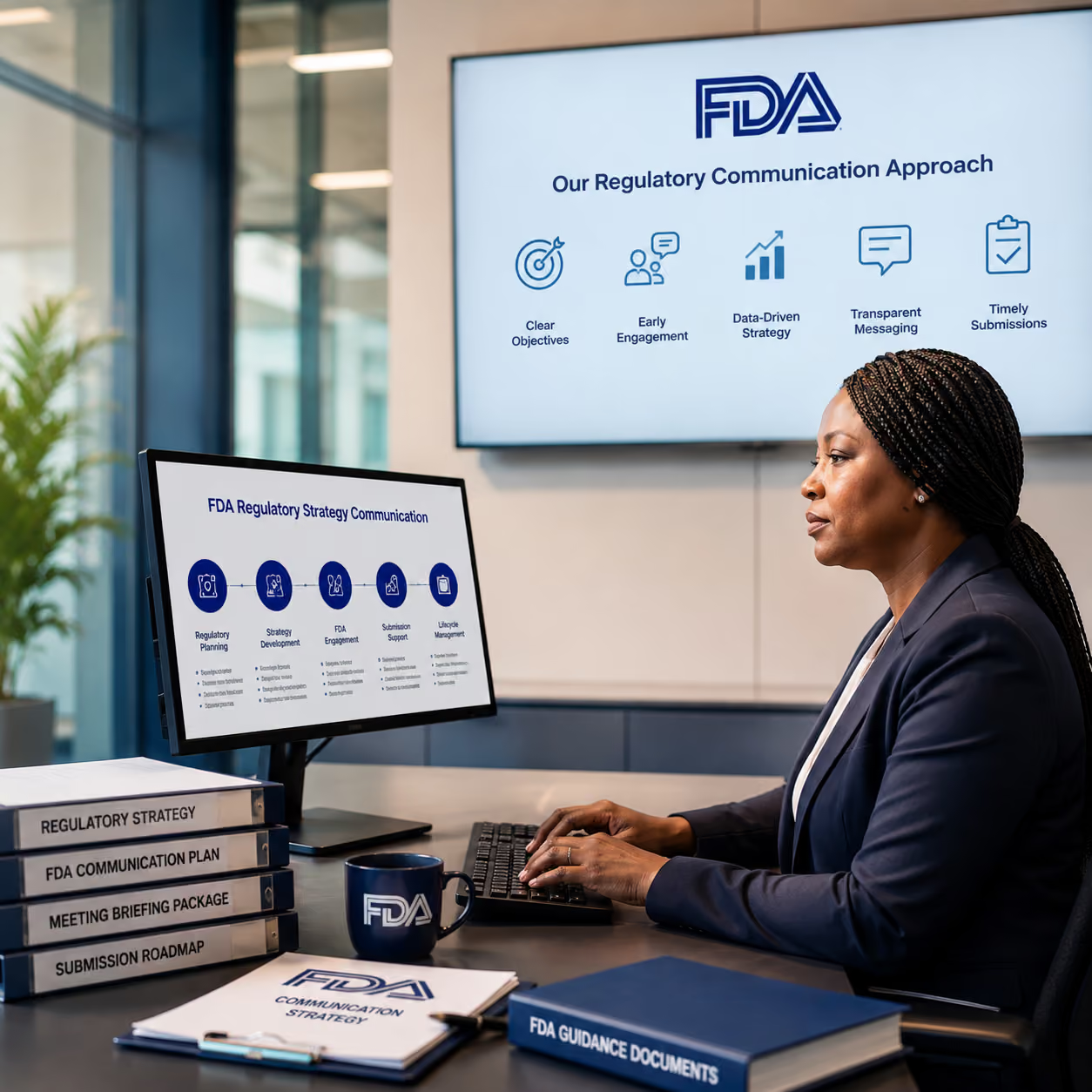
FDA Regulatory Strategy Communications






Why HealthTech Presentations Fail When Clinical Rigor Is Missing
Why Health System Buyers Evaluate Clinical Risk Before Commercial Value
Health system executives, CMOs, CNOs, clinical informaticists, and department physician chiefs evaluate technology decisions through a clinical risk framework fundamentally different from commercial enterprise software buyers. A commercial buyer asks whether something solves a business problem at a justifiable cost. A health system clinical executive asks whether it could harm a patient, how likely that harm is, and what the organization's liability exposure looks like if it happens.
Clinical Risk Comes First, Always
This clinical risk assessment precedes every other evaluation dimension in health system procurement. A HealthTech product with strong commercial ROI, clear competitive differentiation, and excellent reference customers still gets blocked at the clinical committee stage if the evidence does not satisfy the patient safety standard, because the committee's fiduciary responsibility to patients is never subordinate to organizational commercial efficiency.
What the Standard Actually Requires
The patient safety risk assessment health systems apply has specific evidence requirements: peer-reviewed clinical evidence with study populations matching the health system's own patient demographics, FDA regulatory clearance appropriate for the intended clinical use, evidence that workflow integration does not introduce new error modes, and physician champion validation from practitioners who have used the product in comparable clinical environments.
No Evidence, No Advancement
Presentations built without this evidence framework arrive at the clinical committee without the documentation required for a positive recommendation, and the committee simply does not approve technology without evidence. The evaluation does not advance regardless of how enthusiastic the commercial relationship sponsor happens to be about the deal.
Sequence Determines Outcome
This evaluation sequence carries a direct implication for presentation architecture: a HealthTech presentation that leads with commercial value before establishing clinical evidence credibility reaches the clinical committee without the evidence structure required for approval, no matter how well the commercial case was made to the business development sponsor beforehand. A HealthTech presentation design agency that understands health system procurement builds clinical evidence first, not as a response to committee requests, but as the foundation that makes the clinical committee review the validation of an already-established standard.

How the FDA Regulatory Pathway Determines Everything About the HealthTech Business Case
The FDA regulatory pathway for software as a medical device is not a compliance matter. It is a business strategy decision that determines every dimension of the HealthTech business model. A company pursuing 510(k) clearance through a predicate device strategy can reach market in 12 to 18 months. A company requiring De Novo classification because no predicate exists must plan for 24 to 36 months. A company requiring a PMA because their device supports life-sustaining functions faces a multi-year process with clinical trial requirements attached. These are not compliance details. They are the timeline and capital requirements of the entire business plan.
Classification Determines Reimbursement
FDA device classification also determines reimbursement eligibility. Software cleared as a class II medical device may access specific CPT reimbursement codes that non-cleared software cannot reach. That eligibility determines whether the health system deploys the software under its existing clinical program budget or needs a separate capital approval process, directly affecting sales cycle length and commercial deal terms.
A Procurement Prerequisite, Not a Signal
Health system IT departments also require FDA classification documentation before deploying software as a medical device in clinical workflows, creating a direct connection between regulatory status and deployment feasibility that makes the FDA pathway a genuine procurement prerequisite, not merely a market awareness signal investors can skim past.
Presenting the Pathway as Strategy
Enterprise HealthTech presentation design for investor audiences requires presenting FDA regulatory strategy as the business model foundation, explaining what classification is being pursued, why it is appropriate, what the timeline implies for commercial milestones, and how the approval creates competitive barriers non-cleared competitors cannot replicate on the same schedule.
Building It Into the Narrative
Working with a HealthTech presentation design company that understands the FDA regulatory-business model connection means working with a team that builds the regulatory pathway into the business strategy narrative itself, rather than treating it as a compliance slide appended somewhere near the back of the commercial argument

Translating HealthTech Clinical Outcomes Into the Financial Language Health Systems and Payers Act On
Clinical outcomes are measured in clinical units: readmission rates, length of stay, complication incidence, medication adherence percentages, care gap closure rates, and quality measure performance. Health system CFOs and payer medical directors evaluate technology investments in financial units instead: cost per avoided readmission, revenue impact of quality metric improvement under pay-for-performance contracts, total cost of care reduction under shared savings arrangements, and return on investment expressed as dollar savings per member per month.
Where Presentations Stall
The gap between clinical outcome language and financial outcome language is the most consistent reason HealthTech presentations stall at the CFO's office even when the CMO is fully supportive. The CMO approved the clinical evidence. The CFO cannot evaluate the financial investment without understanding what those clinical outcomes translate to inside their specific financial model, and a presentation offering clinical outcomes without financial translation leaves the CFO unable to build an internal business case.
Building the Translation From Real Numbers
StoryFlo's translation framework converts every clinical outcome metric into its financial equivalent using the health system's own publicly available cost data, CMS cost reports, AHRQ benchmarks, and payer contract terms. A 34% reduction in 30-day readmissions for CHF patients translates to a specific dollar figure based on the health system's average readmission cost, the number of CHF patients in the program, and the payer mix affecting readmission penalty exposure. This is not a generic claim. It is a projection built from the health system's own financial context.
HealthTech product presentation design for value-based care markets requires building this financial translation for every major clinical outcome the product produces, not just the headline result, but every secondary outcome that affects financial performance under the specific value-based contract in play.
Closing the Communication Gap
When HealthTech organizations need custom HealthTech presentation design that translates clinical outcome evidence into the financial language health system CFOs and payer medical directors actually act on, StoryFlo's clinical-to-financial translation methodology is built specifically for that exact communication gap.

HealthTech Presentation Engagements Built for Clinical and Commercial Standards
Every engagement begins with a full clinical evidence audit and FDA regulatory status review, mapping every clinical proof asset and regulatory clearance before any presentation architecture is developed. Select the engagement level that matches the clinical complexity of your evidence base and the number of health system stakeholder groups your procurement process requires.
Frequently Asked Questions
We use a business strategy framing rather than a regulatory compliance framing, explaining what classification is being pursued, what it enables for reimbursement eligibility and deployment scope, and why it creates a competitive moat non-cleared competitors cannot replicate quickly. As a HealthTech presentation design agency, we treat the pathway as the business plan foundation, not a skipped section.
Yes. We build the clinical evidence package in the exact format clinical committee quality improvement reviewers use, presenting study design, patient population characteristics, comparison group, outcome measure relevance, and statistical significance in a structure mirroring how committees review new clinical protocols, not how a product demo presents features.
We build a financial model translating every clinical capability into its projected impact on the health system's specific ACO, MSSP, or bundled payment arrangement, using CMS benchmark data and the health system's own payer contract structure. The CFO evaluates it as an investment, and the CMO evaluates it clinically.
Yes. Every adverse event is described with the clinical specificity that lets the quality committee independently evaluate severity, every corrective action is presented with operational specificity that lets the timeline be validated, and every limitation is stated explicitly to prevent overstatement that creates liability exposure.
We build a two-layer architecture: methodology and clinical outcomes presented with the rigor physician reviewers apply to evidence appraisal, and operational and financial implications translated into quality metrics and cost reduction estimates administrators use to evaluate investment. Both layers integrate into one presentation; neither audience reads as built for the other.
Yes. Payer medical directors and CMS reviewers evaluate reimbursement applications against a specific hierarchy: clinical utility beyond existing standard of care, cost-effectiveness per quality-adjusted life year, and implementation feasibility at population scale. Our HealthTech presentation design solutions address this hierarchy in sequence, in the order reviewers actually apply it.
Your HealthTech Platform Improves Care. Build the Presentation That Earns the Clinical Confidence to Prove It.
The HealthTech companies that win the most consequential health system contracts are not the ones with the richest feature sets. They are the ones whose presentations prove, through evidence and regulatory clarity, that their platform is safe and economically justified. Clinical confidence is the currency. A HealthTech presentation design agency is where it gets earned.