
The AI Presentation Design Agency That Earns Technical Trust
StoryFlo is the AI presentation design firm that AI companies, ML infrastructure providers, generative AI platforms, and enterprise AI deployment teams trust when the presentation must convince audiences who are simultaneously skeptical of AI hype and impressed by genuine capability, in the same meeting. AI presentations face a credibility challenge no other industry produces at this scale. Audiences have heard thousands of AI claims fail in production. StoryFlo builds AI startup presentation design and enterprise AI communication that establishes technical credibility before making capability claims, so skepticism becomes confirmation, not rejection.

.png)
![Backlit advertisement sign on a street displaying the word 'ASÍ' with its pronunciation and meaning: 'así (ah-see) adv. [Sp.] a. Like this, b. This way'. Below, text reads: 'CRE Retail Brokerage & Tenant Rep', set against a background of white arches and a corridor.](https://cdn.prod.website-files.com/6a1423bf64953b6741b4dff8/6a50ee682905177218b4e3e3_Header%20Image%2002.png)












Professional AI Presentation Design Services
AI companies face a challenge no other tech sector produces, overcoming years of AI overpromising, establishing genuine technical credibility, and translating probabilistic performance into the deterministic language decision-makers require. Companies that hire AI presentation designers get every service built around this three-part credibility test, since failing any one stalls the deal.
AI Investor Narratives
AI investor presentations face a hype paradox: interest has never been higher, but skepticism about individual claims has never been higher either. A deck leading with "state-of-the-art performance" like every competitor tells investors nothing. StoryFlo leads with technical defensibility, why the model works, why the methodology is superior, before market opportunity.
Enterprise AI Sales Decks
Enterprise AI buyers want to know what happens when the AI is wrong. Most AI sales presentations only describe what happens when it's right. StoryFlo builds decks addressing error rate, confidence scoring, and human override mechanisms, turning uncertainty about AI failure modes from a sales barrier into a trust-building opportunity.
AI Board Communications
Board members are accountable for AI risk, regulatory, reputational, and operational, but most lack the technical depth to evaluate it directly. A presentation showing AI metrics without governance translation leaves the board unable to fulfill fiduciary responsibility. StoryFlo translates technical performance data into board-level governance risk framing.
Responsible AI Presentations
Fairness audits, safety policy briefings, and ESG-aligned AI disclosures must communicate accountability without conceding liability, and demonstrate commitment without overpromising. Built incorrectly, these presentations create regulatory and reputational exposure. StoryFlo builds responsible AI presentations with that exact architectural precision built in.
AI Research Commercialization
Research institutions and university AI labs face the most severe technical-to-commercial translation challenge in technology, academic language, and evidence standards on one side, market timing and scalability evaluation on the other. StoryFlo bridges what the research proves and what the commercial audience needs to hear to commit.
AI Partnership and Integration Decks
AI partnership presentations must establish model quality credibility for the technical team, integration simplicity for the product team, and business impact for BD, simultaneously. Undersell model quality and the technical partner walks. Understate integration complexity and BD won't advance. StoryFlo satisfies all three at once.
Credibility First. Capability Second.
Technical Claim Validation
Audience Skepticism Mapping
Capability Narrative Architecture
Uncertainty and Risk Integration




Tell Us What Your AI Does. We Will Make It Believed.
StoryFlo begins every engagement with a full technical claim validation, evaluating what your AI genuinely does and what your specific audience's skepticism profile requires. Our AI presentation design agency responds within one business day with a proposed credibility architecture built around your specific AI capability and target audience.
Get in Touch
Tell us what your AI does, what your audience doubts, and what decision you need them to make. We will build the credibility architecture that earns it.
AI Capabilities Proven Through Presentation Architecture
Every result below reflects a completed engagement where a genuine AI capability needed presentation architecture that could earn belief from a technically sophisticated, appropriately skeptical audience. These presentations were reviewed by AI-literate investors, enterprise technology leaders, and governance-aware boards who had already dismissed multiple AI claims before this one arrived.
.avif)
AI Computer Vision Startup Closes $34M Series B After Credibility Architecture Rebuild
A computer vision company had pitched Series B to deep tech investors for six months without closing. Their precision and recall were best-in-class on three benchmarks, but their deck led with those numbers without establishing real-world relevance. Every investor passed with a variation of "impressive benchmarks, but I'm not convinced it holds in production." StoryFlo rebuilt the presentation to lead with production deployment evidence, real environments, and real error rates, using benchmarks as confirmatory evidence rather than primary evidence. Series B closed at $34M.
.avif)
Enterprise AI Platform Wins $62M Fortune 100 Deployment Contract After Error Rate Transparency Rebuilt Trust
An enterprise AI workflow company's platform ran at 94% accuracy, genuinely strong performance. Their sales presentation led with that number, and the Fortune 100's compliance team immediately asked about the other 6%, who's liable, what's the override. The sales team had no prepared answer, and the evaluation stalled for three months. StoryFlo rebuilt the presentation to address the 6% before being asked: error classification, confidence scoring, human review triggers, liability allocation. The compliance team became the internal champion. Contract awarded at $62M.
.avif)
AI Research Lab Secures $28M Corporate Partnership After Commercial Translation Rebuild
A university AI research lab with landmark peer-reviewed results couldn't convert research credibility into a corporate partnership. Their presentation was a structured academic paper: hypothesis, methodology, results, future work. The corporate BD team needed to evaluate a partnership opportunity, not assess research contribution. StoryFlo rebuilt it to open with the commercial application, establish the research as the technical foundation, and present the partnership as the mechanism for translating research into deployed value. The partnership closed at $28M the following quarter.
AI Companies. Credibility Earned.
Feedback from AI startups, enterprise AI teams, and research commercialization organizations. Each testimonial reflects a specific credibility outcome, a skeptical audience converted by presentation architecture that earned technical trust.

Our lead investor told us afterward that the production evidence architecture was what converted them from a pass to a commitment. Six months of fundraising had gone nowhere with our benchmark-first deck. StoryFlo flipped the order: production evidence first, benchmarks as confirmation, and we closed our Series B at $34M.
Our compliance evaluator had been blocking this deal for three months, and every meeting ended with unanswered questions about our error rate. StoryFlo rebuilt the deck to address error classification and human override before anyone had to ask. That same evaluator became our internal champion, and we signed the deployment contract at $62M.
Our previous presentations read like the academic paper itself, and corporate partners never advanced past the first meeting. StoryFlo rebuilt it to open with the commercial application instead of the methodology. We closed our first corporate partnership at $28M in the same quarter, something five years of prior pitches never achieved.
A regulatory panel told us our rebuilt responsible AI presentation was the clearest communication of its kind they'd received from a company our size. Our institutional investor's ESG committee approved our AI disclosures without requesting a single piece of additional documentation, which had never happened with our previous materials.
Our board used to sit through technical briefings they couldn't actually evaluate. StoryFlo translated our model performance metrics into governance risk language instead. The first board meeting using the new format produced a real strategic AI conversation, and two board members asked for follow-up sessions afterward.
We used to run separate technical and commercial evaluation meetings for every partnership. StoryFlo built one presentation that satisfied the technical team's model quality bar, the product team's integration concerns, and the business development assessment simultaneously. We signed our first single-cycle partnership agreement, no second meeting required.
Our lead investor told us afterward that the production evidence architecture was what converted them from a pass to a commitment. Six months of fundraising had gone nowhere with our benchmark-first deck. StoryFlo flipped the order: production evidence first, benchmarks as confirmation, and we closed our Series B at $34M.
Every AI Presentation Challenge Solved.
The use cases below span establishing technical credibility with skeptical investors to governing AI risk at board level to earning regulatory trust through disclosure. Our AI presentation design solutions understand the specific trust-building sequence each audience requires.

AI Investor Fundraising Presentations

Enterprise AI Sales and Deployment

AI Board Governance Communications






Why AI Presentations Fail Even When the Technology Is Real
The AI Hype Credibility Gap and Why Your Presentation Starts in a Deficit
Every AI company presenting today inherits a credibility deficit it did not create. The industry's track record of overpromising, chatbots that couldn't hold a conversation, autonomous vehicles that couldn't navigate rain, and fraud detection systems flagging legitimate transactions at unacceptable rates has created sophisticated skepticism in every investor, enterprise buyer, and board member who has evaluated AI claims over the past decade.
A Filter Applied Before You Speak
This inherited skepticism operates as a pre-presentation filter. Before the AI company makes its first claim, the audience has already applied a skepticism discount to everything it's about to hear. The discount varies by type: AI-specialized investors who've seen hundreds of companies have calibrated skepticism, enterprise compliance officers burned by past implementations carry high skepticism, and regulatory bodies have institutionalized skepticism built into their evaluation frameworks.
Why Impressive Numbers Backfire
The standard response to this environment is opening with impressive performance numbers, accuracy rates, benchmark scores, and efficiency improvements, hoping the numbers overcome the skepticism. This fails consistently because the skeptical audience's first response to an impressive number is to question its validity, not be impressed by it. The number triggers the skepticism response rather than bypassing it entirely.
Leading With Method
StoryFlo's alternative starts with the methodology and evidence standard before presenting the claim itself, so the audience evaluates the claim through "I understand how this was measured, and I trust the measurement" rather than "every AI company says this, so what makes you different?" That reframe changes which lens the entire presentation gets read through.
Credibility as the Prerequisite
An AI presentation design agency built for this industry understands that credibility architecture is not an add-on to the capability argument. It is the prerequisite that determines whether the capability argument gets heard at all, regardless of how strong the underlying technology actually is or how much evidence sits behind every claim being made.

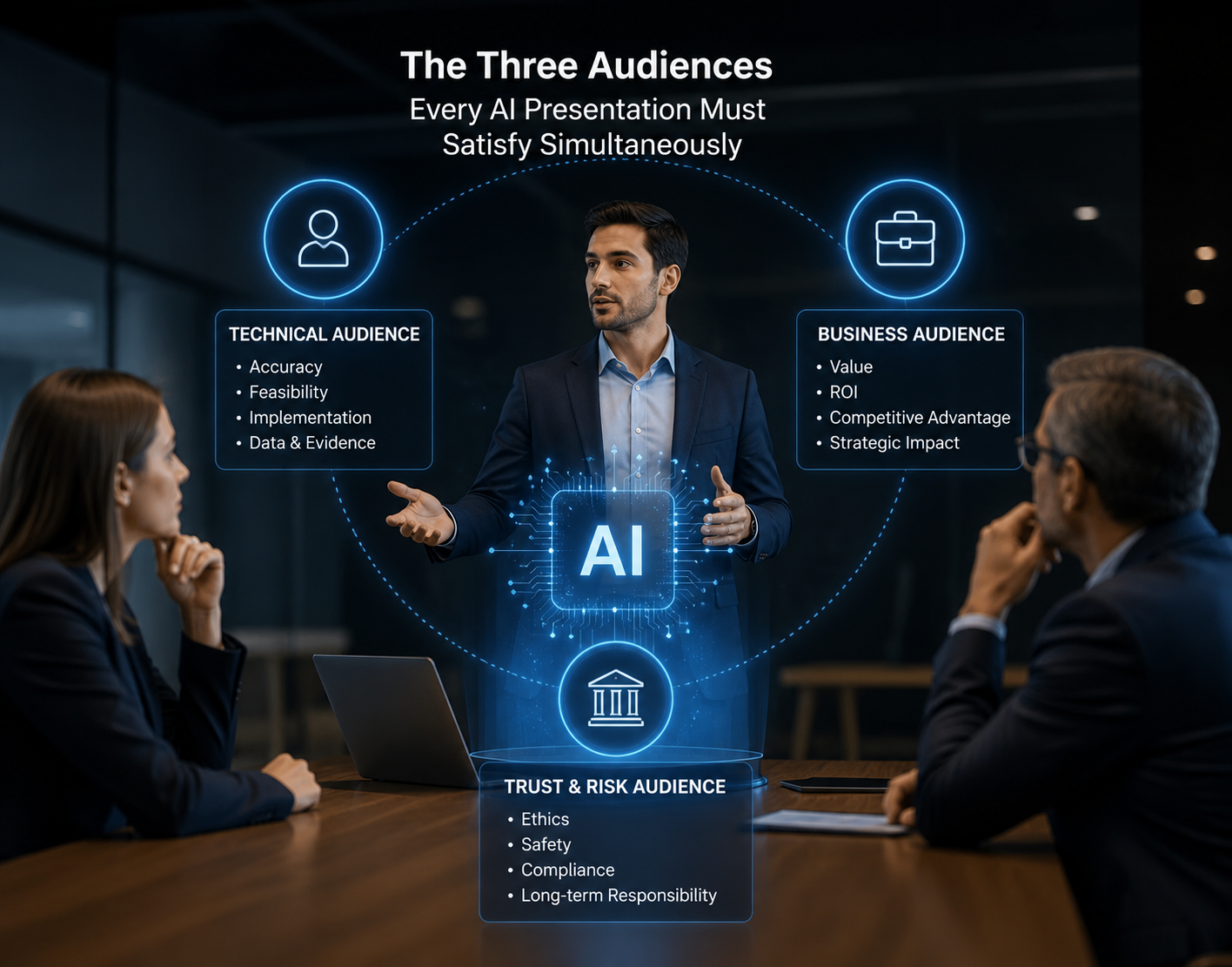
The Three Audiences Every AI Presentation Must Satisfy Simultaneously
AI purchasing decisions in enterprise organizations now involve three distinct audience types who weren't all in the same room five years ago. The technical evaluator, a data scientist, ML engineer, or AI architect, evaluates model quality, training data provenance, and integration architecture. The business decision-maker evaluates outcome impact and competitive advantage. The governance evaluator, a CIO, Chief Risk Officer, or compliance team, evaluates AI risk, bias, and liability exposure.
Same Concept, Three Different Vocabularies
These three evaluator types have different evaluation criteria and different vocabularies entirely. What the technical evaluator calls model drift, the business decision-maker calls degrading performance over time, and the governance evaluator calls material risk requiring monitoring and disclosure. The same concept needs three different framings, and a presentation using only one framing gets fully understood by one audience and partially understood by the other two.
Building the Layering Architecture
AI technology presentation design for this three-audience environment requires specific layering, where each slide carries its primary assertion in business language accessible to all three, supporting evidence in mixed technical and business language, and governance implications in explicit risk language the compliance evaluator needs to assess accountability properly.
Where the Deal Stalls Without It
When this layering is absent, specific failures follow. The technical evaluator is satisfied, but the governance evaluator isn't given enough to assess AI risk, so the deal stalls in compliance review. Or the business decision-maker is excited, but the technical evaluator isn't convinced the model holds in their data environment, so the deal stalls in technical due diligence instead.
Legible, Credible, and Accountable at Once
Working with an AI presentation design company that understands this three-audience structure means working with a team that builds every AI presentation to be legible, credible, and accountable simultaneously, rather than optimized for whichever single audience happened to request the meeting in the first place.
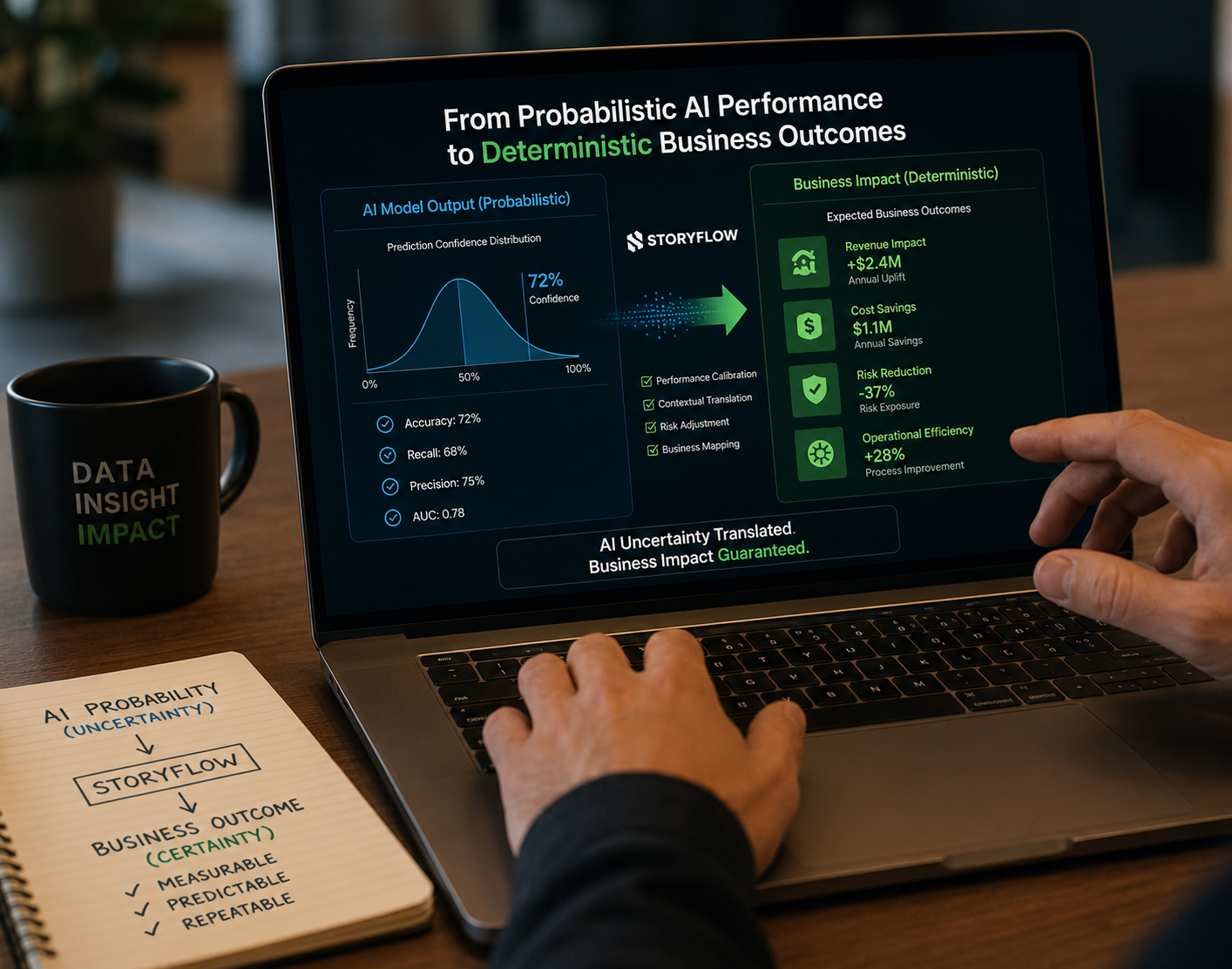
How StoryFlo Translates Probabilistic AI Performance Into Deterministic Business Outcomes
Every AI capability is probabilistic. A model doesn't guarantee it will produce the correct output. It produces the correct output with a certain probability under specified conditions. This isn't a weakness of current AI technology. It's a fundamental characteristic of how machine learning systems work, trained on data distributions and generalizing within those distributions with varying degrees of confidence.
What Business Decision-Makers Actually Need
Business decision-makers evaluate investment decisions deterministically. They need to know what the system will do, not what it will probably do most of the time. When an enterprise buyer asks whether an AI system will correctly identify fraud, the answer "97% precision on our validation set" is technically accurate and practically useless for a business decision. The buyer needs to know what happens in the remaining 3%.
Where the Conversation Ends in Uncertainty
This mismatch, probabilistic capability meeting deterministic evaluation expectation, is where most AI sales presentations break down. The AI company presents probability statistics. The buyer evaluates deterministic risk. The conversation ends in uncertainty rather than commitment, and both sides walk away believing the other side missed the point entirely.
Turning a Statistic Into an Operational Plan
StoryFlo's approach converts probabilistic performance data into deterministic operational frameworks. Instead of "97% precision," the presentation articulates that for every 1,000 flagged transactions, 970 will be correctly identified and 30 will require human review, then shows the review workflow, the average review time, and the cost model for that operation. This converts a probability statistic into an operational plan the buyer can evaluate against existing capacity.
Every Metric Gets the Same Treatment
AI product presentation design for enterprise audiences requires this translation for every key performance metric, not just accuracy, but latency, scalability, retraining frequency, and model governance, converting each technical specification into an operational implication the business can actually plan around. When AI companies need custom AI presentation design built for this exact translation challenge, StoryFlo's methodology exists specifically for it.
AI Presentation Engagements Built for Your Credibility Challenge
Every engagement begins with a technical claim validation and audience skepticism mapping, establishing what your AI genuinely does and what your specific audience doubts. Select the engagement level that matches the complexity of your AI capability, the sophistication of your audience, and the governance requirements your presentation must address.
Frequently Asked Questions
We build the presentation around three substitute credibility signals: the technical validity of the approach and why it generalizes, the quality of the validation environment relative to real-world conditions, and the team's production deployment history from prior roles. As an AI presentation design agency, we know these three signals satisfy sophisticated investors when direct deployment evidence is still too early.
Yes. We build a dedicated governance architecture section addressing error classification, confidence scoring thresholds, human review triggers, model monitoring, and liability allocation, presented before the compliance team asks. Converting the compliance team from evaluator to internal champion is the fastest path to enterprise AI deployment approval, and leading with governance answers gets you there.
We translate every technical metric into its board-level governance implication. Model accuracy becomes liability exposure, model drift becomes material risk requiring disclosure, training data provenance becomes compliance evidence, and fairness audit results become ESG documentation. Board members get the specific information needed to fulfill fiduciary AI governance responsibility without needing the underlying ML methodology.
Yes. Responsible AI presentations must navigate a narrow corridor, acknowledging AI risks honestly without creating liability through overadmission, and demonstrating governance commitments credibly without overpromising outcomes model uncertainty makes impossible to guarantee. We build language satisfying regulatory transparency requirements and institutional investor ESG standards while keeping every commitment technically defensible.
The primary translation is basically objective reframing. The academic paper addresses a research question; the corporate partnership presentation must address a commercial opportunity. We open with the commercial application the breakthrough enables, establish the research as the technical foundation for that application's defensibility, and present the partnership as the mechanism for scaling it.
Yes. AI platforms often serve multiple verticals where the same capability addresses entirely different problems. A computer vision platform might serve manufacturing quality control and healthcare diagnostic imaging simultaneously. Our AI presentation design solutions build a consistent core capability narrative with interchangeable vertical sections translating that capability into each industry's specific business language and evaluation framework.
Your AI Is Real. The Presentation Proving It Needs to Be Just as Good.
The AI companies that close the most consequential investments and enterprise deployments are not the ones with the most advanced models. Often those models cannot communicate their capabilities credibly to the audiences controlling the resources needed to deploy them. The capability exists. An AI presentation design agency is what determines whether it reaches the market or stays in the lab.