
The SaaS Presentation Design Agency That Speaks Your Metrics
StoryFlo is the only presentation design agency built specifically for the SaaS business model, fluent in ARR, NRR, CAC payback, LTV/CAC ratios, cohort retention, logo churn, and expansion revenue. Most agencies design for general business audiences, forcing SaaS companies to translate their metrics into generic language and losing precision along the way. StoryFlo builds presentations in the language SaaS audiences already think in, so the argument arrives pre-translated. From SaaS startup presentation design at seed stage through enterprise board communications at scale, StoryFlo builds for SaaS companies exclusively.

.png)
![Backlit advertisement sign on a street displaying the word 'ASÍ' with its pronunciation and meaning: 'así (ah-see) adv. [Sp.] a. Like this, b. This way'. Below, text reads: 'CRE Retail Brokerage & Tenant Rep', set against a background of white arches and a corridor.](https://cdn.prod.website-files.com/6a1423bf64953b6741b4dff8/6a50ee682905177218b4e3e3_Header%20Image%2002.png)











Professional SaaS Presentation Services
SaaS companies present more frequently and to more diverse audiences than almost any other industry, investor meetings, board reviews, enterprise sales, customer QBRs, and product launches on overlapping timelines. Most SaaS companies hire SaaS presentation designers who build one dedicated system per audience type, not one deck stretched across all of them.
SaaS Investor Narratives
SaaS investors evaluate on a specific hierarchy: ARR trajectory, NRR as the compound growth engine, CAC payback as capital efficiency evidence, and cohort retention as durability proof. A deck leading with TAM and features instead of this hierarchy signals the founding team doesn't understand how their business gets evaluated.
SaaS Board Communications
Board decks are not one-time pitch events, they're an ongoing narrative arc where each quarterly deck builds on the last, addresses prior commitments, and sets up the next cycle's strategic questions. Most SaaS companies treat board decks as data dumps. StoryFlo builds them as narrative systems.
Enterprise Sales Decks
Enterprise sales decks must translate product value for each buyer persona simultaneously, the CTO evaluates integration and security, the CFO evaluates TCO and ROI timeline, the business unit VP evaluates operational impact. A single narrative trying to satisfy all three satisfies none
Customer Success QBRs
QBRs are the most underinvested presentation type in SaaS. Most customer success teams present usage tables and ticket summaries with no strategic narrative connecting outcomes to value delivered. StoryFlo turns routine data reviews into strategic retention and expansion conversations.
SaaS Partner Channel Decks
Partner presentations must communicate revenue share, deal registration, technical enablement, and co-marketing investment with enough specificity that a partner can evaluate the opportunity against competing platforms. Most SaaS partner decks are sales decks with a logo swapped in.
SaaS Product Launch Decks
Product launch presentations must translate engineering output into customer value impact without oversimplifying capability or overpromising outcomes. A launch deck built by product speaks feature language. One built by StoryFlo speaks business impact language with feature evidence
Built on SaaS Operating Logic
ICP and Audience Definition
Value Proposition Architecture
Design and MVP Delivery
Iteration and Final Release




Tell Us Your Stage. We Will Build for Your Audience.
StoryFlo calibrates every engagement to your current growth stage, because a seed-stage investor narrative and a growth-stage board presentation require completely different architecture. Our SaaS presentation design agency responds within one business day with a proposed approach built around your specific growth stage and presentation need.
Get in Touch
Tell us your ARR range, your current growth stage, and the audience for your next presentation. We will build from there.
SaaS Metrics That Moved After Our Decks
Every result below reflects a SaaS company whose specific business metric, close rate, expansion revenue, fundraise conversion, or board confidence, improved measurably after StoryFlo rebuilt the presentation driving it. These presentations were evaluated by SaaS-native investors, enterprise procurement teams, and board members who evaluate SaaS businesses daily against the same metrics your company tracks.
.avif)
Series A SaaS Company Closes $26M After Unit Economics Narrative Rebuild, Previous 14 Investor Declines
A SaaS company at $4M ARR had been declined by 14 investors over five months of Series A fundraising. Their deck led with product features and market size, the standard startup framework. Experienced SaaS investors need NRR, cohort retention, and CAC payback before they engage with market size. StoryFlo rebuilt the deck to lead with 125% NRR, Month 12 retention above 90%, and CAC payback under 14 months, then presented market opportunity as the scale variable applied to an already proven engine. Series A closed at $26M.
.avif)
Enterprise SaaS Company Reduces Sales Cycle from 9 Months to 4 Months with Modular Sales Deck System
An enterprise SaaS company at $40M ARR had a sales cycle extended to 9 months because different stakeholders received different messages from different reps at different stages. The business unit VP needed operational impact, the CTO needed integration architecture, the CFO needed TCO comparison. StoryFlo built a modular presentation system, a core narrative with stakeholder-specific sections the account executive could assemble per meeting. Sales cycle compressed from 9 to 4 months. Win rate improved 22% in the first two quarters.
.avif)
Growth-Stage SaaS Company Increases NRR 18 Points After QBR Presentation System Redesign
A SaaS company at $25M ARR had net revenue retention plateaued at 108%, acceptable but insufficient for the growth rate investors required. Their customer success team's QBRs were usage summaries with no narrative connecting platform value to business outcomes. Customers renewed but didn't expand. StoryFlo redesigned the QBR to lead with the customer's stated objective, present platform performance against it, then surface the specific expansion opportunity that would accelerate progress. NRR increased to 126% over three quarters.
SaaS Leaders. Metric Outcomes.
Feedback from SaaS founders, CROs, and customer success leaders across growth stages. Each testimonial reflects a specific SaaS metric that improved after StoryFlo rebuilt the presentation that drove it.

Fourteen investors had passed before we called StoryFlo. They rebuilt our deck to lead with unit economics instead of features. Our lead investor specifically cited the NRR and cohort retention evidence when they sent the term sheet. We closed our round from the next three meetings after five months of nothing.
Our reps were building custom decks for every prospect because nothing covered every buyer persona at once. StoryFlo built us a modular system with stakeholder-specific sections instead. Sales cycle dropped from 9 months to 4, and win rate improved 22% in the first two quarters after we rolled it out.
Our QBRs were usage data nobody remembered a week later. StoryFlo redesigned them to lead with the customer's actual business objective instead. NRR climbed from 108% to 126% over three quarters, and expansion conversations shifted from reactive to proactive because the narrative surfaced the opportunity first.
Our board meetings used to be two-hour metrics reviews. StoryFlo rebuilt our board communication as a quarterly narrative arc instead of a data package. The first meeting using the new format produced an actual strategic discussion, and our board chair asked that every future update follow this same structure.
Our partner recruitment deck was our sales deck with a logo swapped in. StoryFlo rebuilt it to lead with partner economics, revenue share, deal registration, technical enablement, instead of product features. Partner pipeline grew 40% the following quarter, and three partners who'd previously declined reengaged after seeing the new deck.
Our product launches used to be feature lists nobody outside engineering could translate into value. StoryFlo rebuilt our launch deck around customer business impact instead. Adoption for the launched capability was 3x our previous three launches combined, and our sales team ended up repurposing the deck as a selling tool.
Fourteen investors had passed before we called StoryFlo. They rebuilt our deck to lead with unit economics instead of features. Our lead investor specifically cited the NRR and cohort retention evidence when they sent the term sheet. We closed our round from the next three meetings after five months of nothing.
Every SaaS Presentation Type. Covered.
The use cases below represent every presentation category a SaaS company produces across its growth lifecycle, from first institutional fundraise to enterprise-scale governance. Our SaaS presentation design solutions match each use case to its specific audience evaluation framework.









Why SaaS Companies Need a Presentation Agency That Speaks Their Language
Why Generic Presentation Agencies Consistently Fail SaaS Companies
Generic presentation agencies build for general business audiences. They know how to structure a persuasive argument, design polished slides, and tell a compelling story. What they do not know is what NRR means and why it matters more than revenue growth rate. They do not know that a SaaS investor evaluates CAC payback before market size, or that a SaaS enterprise buyer evaluates TCO and integration architecture before product features.
The Translation Tax
When a SaaS company hires a generic agency, the company must translate its internal metrics language into generic business language the agency can work with. This translation introduces three problems: the precision of the original metrics gets lost, the argument sequence gets restructured around generic storytelling conventions rather than SaaS-specific evaluation frameworks, and the final presentation speaks to the agency's understanding of business rather than the audience's understanding of SaaS.
The Credibility Gap in the Room
When a SaaS investor evaluates two pitch decks, one built by a generic agency and one built by a SaaS-native team, the generic deck reads as "we need to explain our business to you," while the native deck reads as "we already operate in your evaluation framework." The second company enters the meeting with a credibility advantage the first company cannot recover through the quality of their answers alone, no matter how strong the underlying business actually is.
The Same Dynamic Everywhere
The same dynamic applies to enterprise sales decks, board presentations, and QBRs. Every audience type that evaluates SaaS businesses has a specific metrics and evaluation framework built into how they think. A presentation that does not speak that framework creates friction at the exact moment it should be creating confidence, and that friction shows up as extra meetings, unanswered objections, and stalled decisions.
Built Native From the Start
A SaaS presentation design agency built specifically for SaaS companies eliminates this translation loss entirely. Every presentation is built natively in the metrics language the audience already uses, so nothing gets lost between what the company means and what the room actually hears when the deck opens.

How SaaS Metrics Hierarchies Differ by Audience, and Why That Shapes Every Deck
Every SaaS audience type uses the same core metrics, ARR, NRR, CAC, LTV, churn, gross margin, burn rate, but they evaluate them in a different hierarchy depending on what they're actually trying to determine about the business at that specific moment in the relationship.
How the Investor Hierarchy Shifts by Stage
Early-stage investors evaluate growth rate first and unit economics second, because they want to see velocity above all else. Growth-stage investors flip that order, evaluating unit economics first and growth rate second, because they want to see efficiency. Late-stage and pre-IPO investors evaluate margin structure first, NRR second, and growth rate third, because durability matters more than speed at that point. A deck presenting the same hierarchy to a seed investor and a Series C investor satisfies neither one completely.
What Enterprise Buyers Actually Care About
Enterprise SaaS presentation design considerations for buyers look completely different from investor considerations. SaaS enterprise buyers evaluate TCO against the incumbent vendor, implementation timeline and resource requirements, integration architecture compatibility, and a measurable ROI timeline. They do not evaluate ARR or NRR, those are internal company metrics that mean nothing to a buyer evaluating a purchase decision. A sales deck that leads with company growth metrics instead of buyer outcome metrics signals the company is selling to itself, not to the customer sitting across the table.
What Boards Are Actually Grading
Board members evaluate financial performance against the plan committed in the prior quarter, strategic progress on the key initiatives the CEO identified, and risk factors that have changed since the last meeting. Board decks that present metrics without connecting them to plan commitments and strategic narrative read as data reporting rather than governance communication, and boards notice the difference immediately.
Matching the Framework, Not Just the Numbers
Working with a SaaS presentation design company that understands these hierarchy differences means working with a team that builds the right metrics framework for each audience, not one deck with the same metrics sequence stretched across every room it walks into.

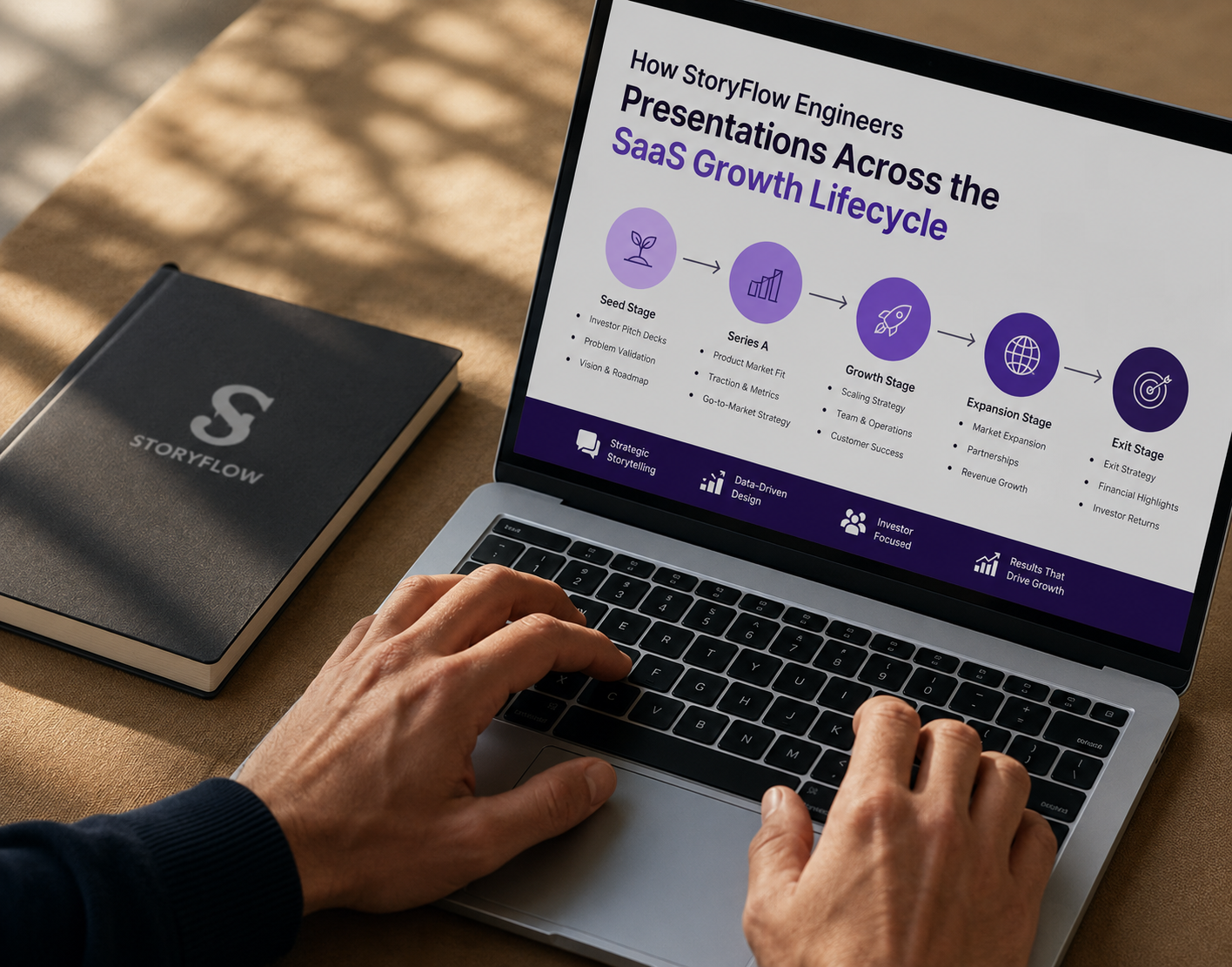
How StoryFlo Engineers Presentations Across the SaaS Growth Lifecycle
The SaaS growth lifecycle creates a continuously evolving presentation requirement set. At seed stage, the primary need is the investor narrative, built on vision, founding team credibility, and early signal rather than metrics, because statistically significant metrics do not yet exist. At Series A, the narrative shifts to unit economics and early cohort evidence. At Series B and beyond, it becomes a growth quality and capital efficiency argument entirely.
The Sales Deck Evolves Alongside the Team
The sales presentation evolves in parallel. At early stage, the founder is the salesperson and the deck is secondary to the conversation itself. At growth stage, the sales team needs a modular deck system because the founder is no longer in every meeting. At enterprise scale, the sales deck becomes a strategic account management tool serving multiple stakeholders across a multi-month sales cycle.
Product Presentations Mature With the Platform
SaaS product presentation design evolves as the platform matures too. Early-stage launch presentations introduce new capabilities to a small, engaged user base who already understand the product deeply. Growth-stage product presentations must reach a broader audience with varying levels of product literacy. Enterprise-stage presentations must communicate platform direction to customers whose own businesses depend on the roadmap decisions being made.
Board Decks Change Their Job Entirely
The board communication evolves the same way. Early-stage board decks are strategic conversations about direction. Growth-stage board decks become performance accountability documents. Enterprise-stage board decks turn into governance instruments that set the framework for the company's most consequential decisions, a fundamentally different job than the one they started with.
Infrastructure, Not a One-Time Project
When SaaS companies at any growth stage need custom SaaS presentation design built for their specific lifecycle moment and audience mix, StoryFlo's methodology scales across the entire journey, not as a one-time engagement but as presentation infrastructure that evolves as the company grows into its next stage and the next audience after that.
SaaS Presentation Engagements Calibrated to Your Growth Stage
Every engagement begins with a growth stage and audience assessment, mapping your SaaS metrics maturity and your primary audience's evaluation framework. Select the engagement level that matches your growth stage and the complexity of the audience evaluating your next presentation.
Frequently Asked Questions
Seed-stage decks lead with market problem validation, founding team credibility, and early signal evidence, since statistically significant unit economics don't yet exist. Growth-stage decks lead with unit economics quality, NRR, CAC payback, cohort retention, since growth-stage investors evaluate efficiency and durability before opportunity. Our SaaS presentation design agency builds the metrics sequence for the specific stage you're targeting.
Yes. We build enterprise SaaS sales decks as modular systems, a core platform narrative that stays consistent, with interchangeable stakeholder-specific sections for technical, financial, and business unit evaluators. Each section addresses the criteria that specific buyer persona applies. A configuration guide tells your account executive which modules to assemble for each meeting type and deal stage.
Most QBRs present usage data without connecting it to the customer's business objectives, so the customer sees activity but not value. We build QBRs that lead with the customer's stated objective, present platform performance against it using outcome metrics rather than activity metrics, then surface the specific expansion capability that accelerates their next business milestone.
Yes. We build SaaS board communications as a quarterly narrative template carrying the strategic story from one meeting to the next, with sections referencing prior commitments, current execution, and forward priorities. This turns the board meeting from a data review into a strategic governance conversation, and gives the CEO one repeatable framework for every quarterly update going forward.
Seed-stage leads with problem validation and founding team. Series A leads with NRR and early cohort retention. Series B leads with CAC payback, LTV/CAC ratio, and gross margin trajectory. Series C and beyond leads with ARR growth rate at scale and capital efficiency ratio. We match the sequence to your current stage and investor's evaluation framework.
Yes. Pre-IPO presentations must communicate the investment thesis in the framework public market analysts apply, durable growth rate, gross margin structure, operating leverage pathway, and free cash flow timeline. Our SaaS presentation design solutions translate the private-market narrative that worked for growth-stage VCs into the story institutional public market investors actually need to hear.
Your SaaS Metrics Tell a Story. Make Sure the Presentation Tells It Right.
The difference between SaaS companies that close rounds, win enterprise deals, retain customers, and earn board confidence, and those that don't, is rarely the quality of the underlying business. It is the quality of the presentation. Every SaaS audience has a specific evaluation framework. StoryFlo is the SaaS presentation design agency that builds natively for it.