
The EdTech Presentation Design Agency That Proves Learning Outcomes
StoryFlo is the EdTech presentation design agency that K-12 platform providers, higher education vendors, corporate learning platforms, and adaptive learning companies trust when the presentation must demonstrate learning efficacy to educators and financial returns to investors, two frameworks that rarely coexist without one undermining the other. Educators are professionally trained to evaluate outcomes, not features, and can distinguish engagement metrics from actual learning. StoryFlo builds EdTech startup presentation design where learning outcome evidence is the architectural foundation, not a marketing layer applied after the features are shown.

.png)
![Backlit advertisement sign on a street displaying the word 'ASÍ' with its pronunciation and meaning: 'así (ah-see) adv. [Sp.] a. Like this, b. This way'. Below, text reads: 'CRE Retail Brokerage & Tenant Rep', set against a background of white arches and a corridor.](https://cdn.prod.website-files.com/6a1423bf64953b6741b4dff8/6a50ee682905177218b4e3e3_Header%20Image%2002.png)










Professional EdTech Presentation Design Services
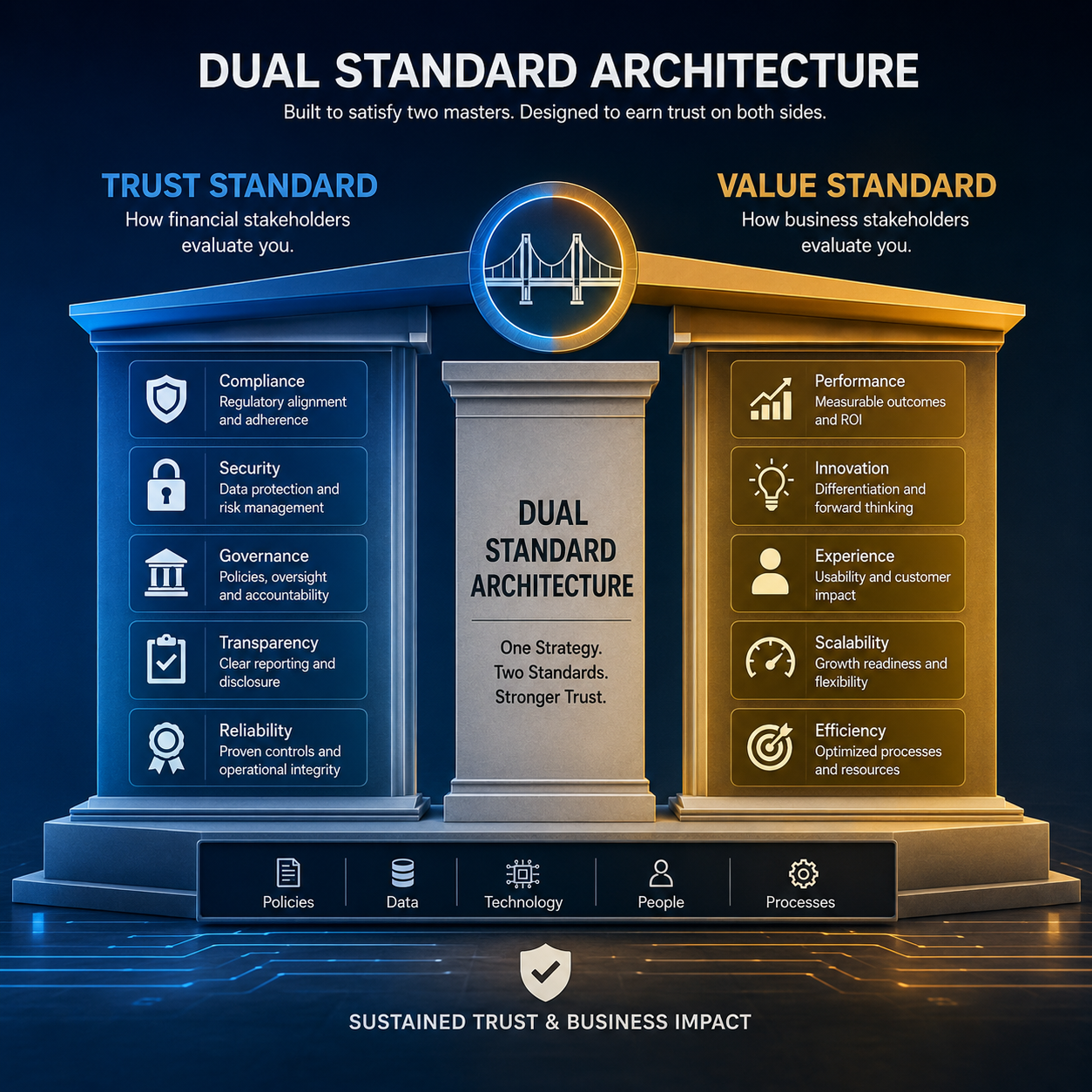
EdTech companies must satisfy two standards simultaneously. Learning outcomes for educators and business returns for investors. Most presentations satisfy one at the expense of the other. Companies that hire EdTech presentation designers get every service built to satisfy both standards at once, without compromising either.
EdTech Investor Narratives
EdTech investors evaluate a categorically different risk profile than general SaaS investors, regulated markets, public funding dependencies, and procurement cycles exceeding 18 months. StoryFlo explains the EdTech business model on its own terms, not as SaaS with educational customers, but as an education business using software to deliver outcomes at scale.
District Procurement Presentations
K-12 procurement involves curriculum directors evaluating pedagogy, IT directors evaluating security, principals evaluating classroom feasibility, and board members evaluating budget, any one of whom can terminate a deal. StoryFlo builds stakeholder-sequenced presentations addressing each evaluation framework in the order the district's process actually requires.
Higher Education Partnership Decks
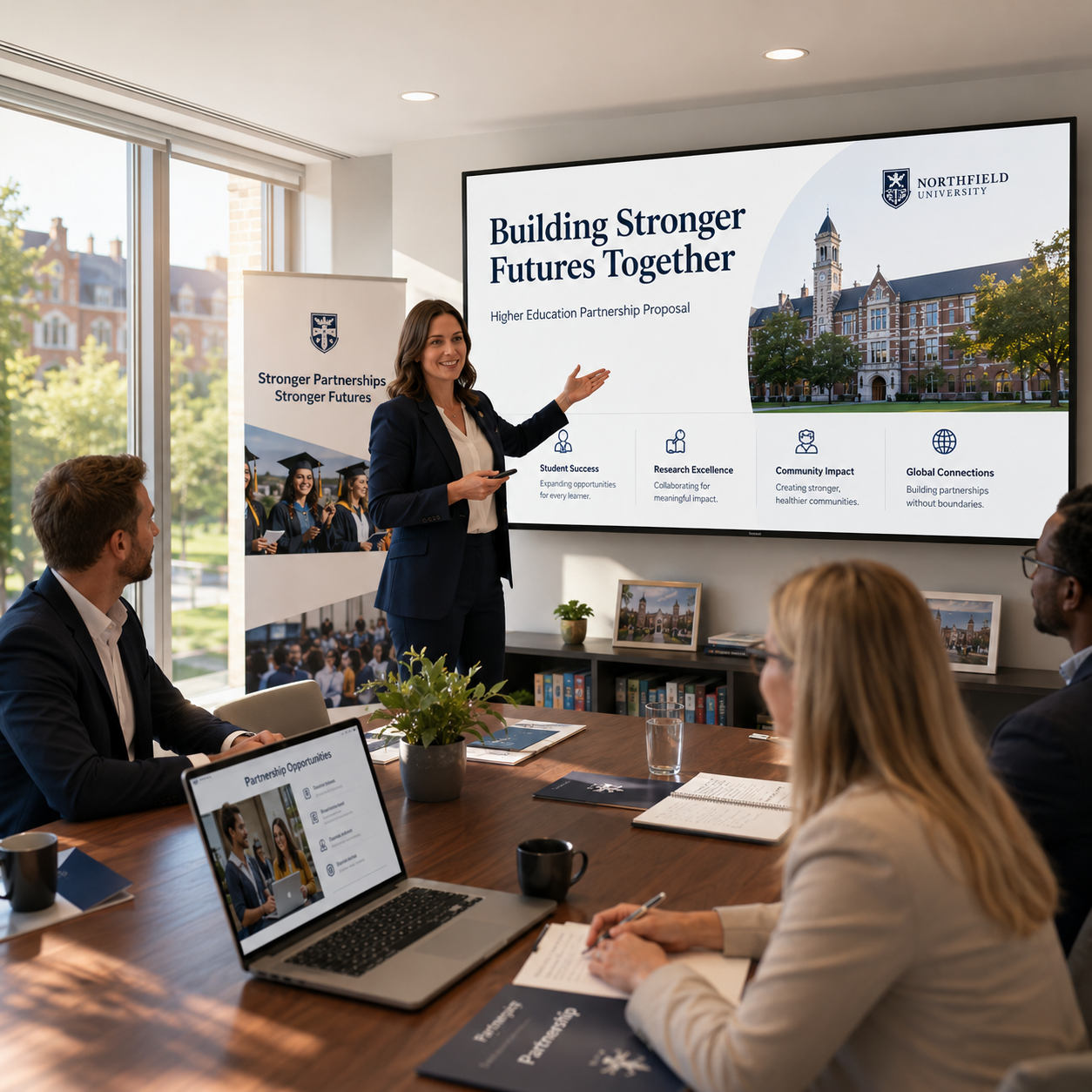
University technology partnerships face shared governance, faculty senate input, academic affairs review, IT governance, and administrative approval, all of which must align. A presentation built for one stakeholder's criteria gets reviewed by five others with different priorities. StoryFlo anticipates the full governance chain before the formal presentation begins.
Corporate Learning Pitches
Sophisticated CLOs have learned that completion rates and satisfaction scores don't correlate with performance improvement. They want evidence employees actually apply what they learned. StoryFlo builds corporate L&D presentations that distinguish learning transfer evidence from engagement evidence, the distinction that separates credible platforms from completion-metric vendors.
Education Grant Proposals
Federal and foundation education grants require academic proposal evidence quality and commercial implementation scalability simultaneously, satisfying program officers evaluating research rigor and staff evaluating organizational capacity to deploy at scale. StoryFlo builds grant presentations that carry both standards without weakening either one.
EdTech Product Launches
Educators face the most severe adoption barrier in enterprise software. Limited time, professional skepticism, and concern that new features mean more work before any value appears. StoryFlo leads with workflow reduction and learning outcome evidence before introducing feature capability, addressing the adoption barrier before it becomes a deployment obstacle.
Learning Evidence Leads Everything
Learning Outcome Evidence Audit
Stakeholder Priority Mapping
Dual Standard Architecture
Adoption Barrier Integration



Share Your Learning Evidence. We Will Build the Case for Both Audiences.
StoryFlo begins every engagement with a full learning outcome evidence audit, mapping every research study and achievement metric your organization has before building anything. Our EdTech presentation design agency, StoryFlo, responds within one business day with a proposed approach built around your specific learning evidence profile and institutional audience.
Get in Touch
Tell us your learning outcome evidence, your target institution type, and your current procurement stage. We will build from there.
EdTech Outcomes That Moved Institutions and Investors
Every result below reflects a completed engagement where an EdTech organization needed to move a complex institutional decision process and a commercial investor evaluation simultaneously. These presentations were evaluated by curriculum directors, district administrators, higher education governance committees, and EdTech investors who apply professional learning science standards to every claim.
.avif)
K-12 Adaptive Learning Platform Wins $47M District Contract After Stakeholder Alignment Rebuild
An adaptive learning platform had been in a large urban district's evaluation for seven months without advancing. Their IES-funded RCT showed significant reading gains, but the procurement presentation was a product demo focused on features. The curriculum director was impressed. IT had unresolved FERPA questions. The CFO had no budget document. The board had never seen the efficacy evidence. StoryFlo rebuilt it as a stakeholder-sequenced series: curriculum briefing, IT data governance, CFO TCO analysis, and board executive summary. Contract awarded at $47M.
.avif)
EdTech Startup Closes $19M Series A After Learning Science Investor Narrative Rebuild
An adaptive assessment startup had pitched Series A for four months with a standard SaaS narrative, ARR, CAC, market size, and consistently heard the business was "hard to underwrite." Their three peer-reviewed studies demonstrating significant learning gains were never mentioned in the deck. StoryFlo rebuilt the presentation to lead with learning science differentiation as the defensible competitive moat, then presented the business model as the mechanism for deploying that capability at scale. Series A closed at $19M with an education-focused fund that had previously declined.
.avif)
Corporate L&D Platform Wins Fortune 500 Enterprise Contract by Proving Learning Transfer
A CLO evaluating three competing L&D platforms found their presentations nearly identical, all led with completion rates and satisfaction scores. She specifically asked each vendor for evidence of skill application after training. Two vendors couldn't provide it. The third had the data but hadn't built it into their deck. StoryFlo rebuilt the presentation to lead with three anonymized case studies showing measurable skill application improvement, before presenting the course library. Enterprise contract awarded.
EdTech Leaders. Learning Outcomes.
Feedback from EdTech founders, district administrators, and L&D leaders across learning sectors. Each testimonial reflects a specific learning outcome or institutional procurement result, the two metrics that define whether an EdTech presentation succeeded.

Our IT director specifically cited the FERPA documentation section as the piece that finally resolved their evaluation blocker. StoryFlo rebuilt our procurement pitch as separate briefings for curriculum, IT, finance, and the board instead of one deck trying to serve all four. Seven months stalled, then $47M signed.
Every investor told us our business was hard to underwrite, and we never once mentioned our three peer-reviewed studies in the pitch. StoryFlo rebuilt it to lead with the learning science instead of SaaS metrics. The fund partner cited that evidence directly when they explained why they were investing this time, after declining us before.
We were competing against two other vendors with nearly identical decks, all completion rates and satisfaction scores. StoryFlo rebuilt ours around actual skill application evidence instead. The CLO who made the final decision told us directly that the transfer evidence was what separated us from the other two.
University shared governance had killed partnerships for us before. Faculty senate, IT governance, academic affairs, and administration all reviewed separately. StoryFlo mapped the full chain and built evidence for each reviewer before we presented. This became our largest university partnership ever, and it moved straight to a signed agreement.
Two prior IES submissions were declined for insufficient implementation evidence. StoryFlo rebuilt our application to carry both academic rigor and organizational scalability at once. The program officer specifically cited our implementation feasibility section when explaining why this submission got funded at the full request amount.
Teachers usually resist new features because it means more work before any benefit shows up. StoryFlo led our launch presentation with workflow reduction evidence before showing the learning outcome data. Adoption for this feature was four times our previous two launches combined, and teachers told us the workflow evidence is what convinced them.
Our IT director specifically cited the FERPA documentation section as the piece that finally resolved their evaluation blocker. StoryFlo rebuilt our procurement pitch as separate briefings for curriculum, IT, finance, and the board instead of one deck trying to serve all four. Seven months stalled, then $47M signed.
Every EdTech Presentation Challenge. Addressed.
These use cases span first investor meeting through enterprise district renewal. Each is built around EdTech's dual evaluation standard, the learning outcomes standard educational audiences apply, and the business return standard commercial audiences apply. Our EdTech presentation design solutions address both simultaneously.

EdTech Investor and Fundraising Presentations
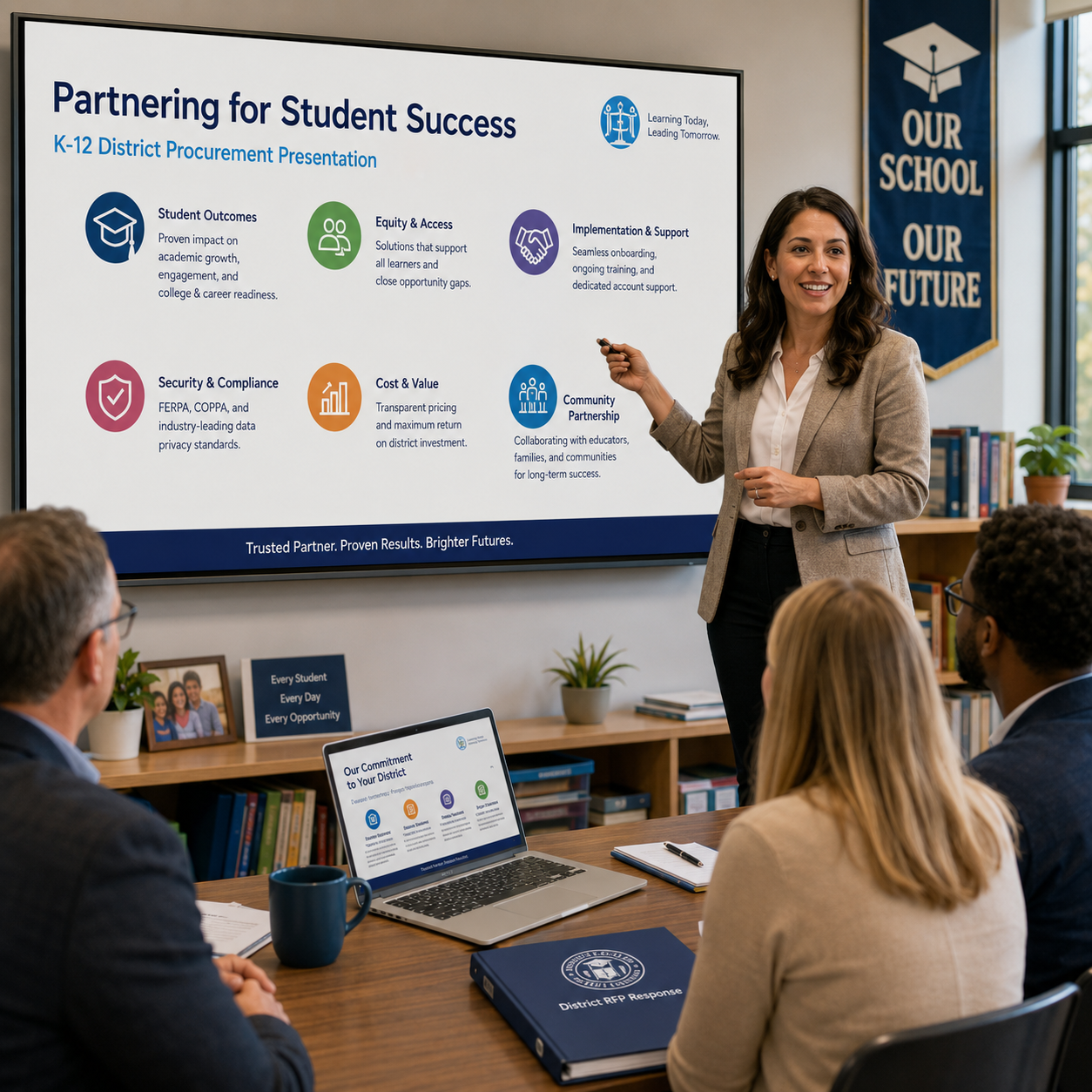
K-12 District Procurement Presentations
Higher Education Partnership Presentations






Why EdTech Presentations Fail the Audiences That Control the Decision
Why Educators Distrust EdTech Presentations That Lead With Product Rather Than Evidence
Educators and administrators have a professional orientation toward evidence fundamentally different from commercial buyers. Teachers are trained to evaluate learning effectiveness through observable student outcomes, research-based pedagogical alignment, and formative assessment feedback. They apply this same standard to EdTech products, asking not whether a platform does what it claims, but whether it improves what students actually learn.
Two Decades of Accumulated Distrust
Education technology has accumulated real distrust over two decades: whiteboard tools that disrupted classroom flow without improving learning, tablet programs that increased screen time without increasing comprehension, and adaptive platforms that adapted engagement rather than achievement. Educators have been burned by technology measuring the wrong things, like clicks, completion, time-on-task, and marketed as learning improvement anyway.
Why Feature-First Presentations Fail Immediately
Every EdTech vendor opening with platform features and engagement metrics is received through the lens of this accumulated distrust. The educator's response to a feature-first presentation isn't curiosity. It's a direct request to see the research, and that request arrives before the product demonstration even begins.
What Show Me the Research Actually Means
That request means something specific to educators: published efficacy studies with control groups, IES or WhatWorks Clearinghouse recognition where applicable, peer-reviewed publication in recognized journals, and implementation case studies from comparable environments with comparable student populations, not cherry-picked success stories from ideal conditions that don't reflect a real classroom.
Dismissed Before the Demo Starts
EdTech presentations built without this research architecture aren't evaluated critically. They're dismissed outright before the product demonstration begins, because the educator has already concluded this is another vendor that can't demonstrate learning improvement, no matter how the interface looks.
Evaluated Like Curriculum, Not Like Software
An EdTech presentation design agency built for educational audiences understands that educators evaluate products the same way they evaluate curriculum, through the lens of what students will actually learn as a result, not what the platform promises to do on the surface.

The Multi-Stakeholder Veto Problem That Kills EdTech Procurement Evaluations
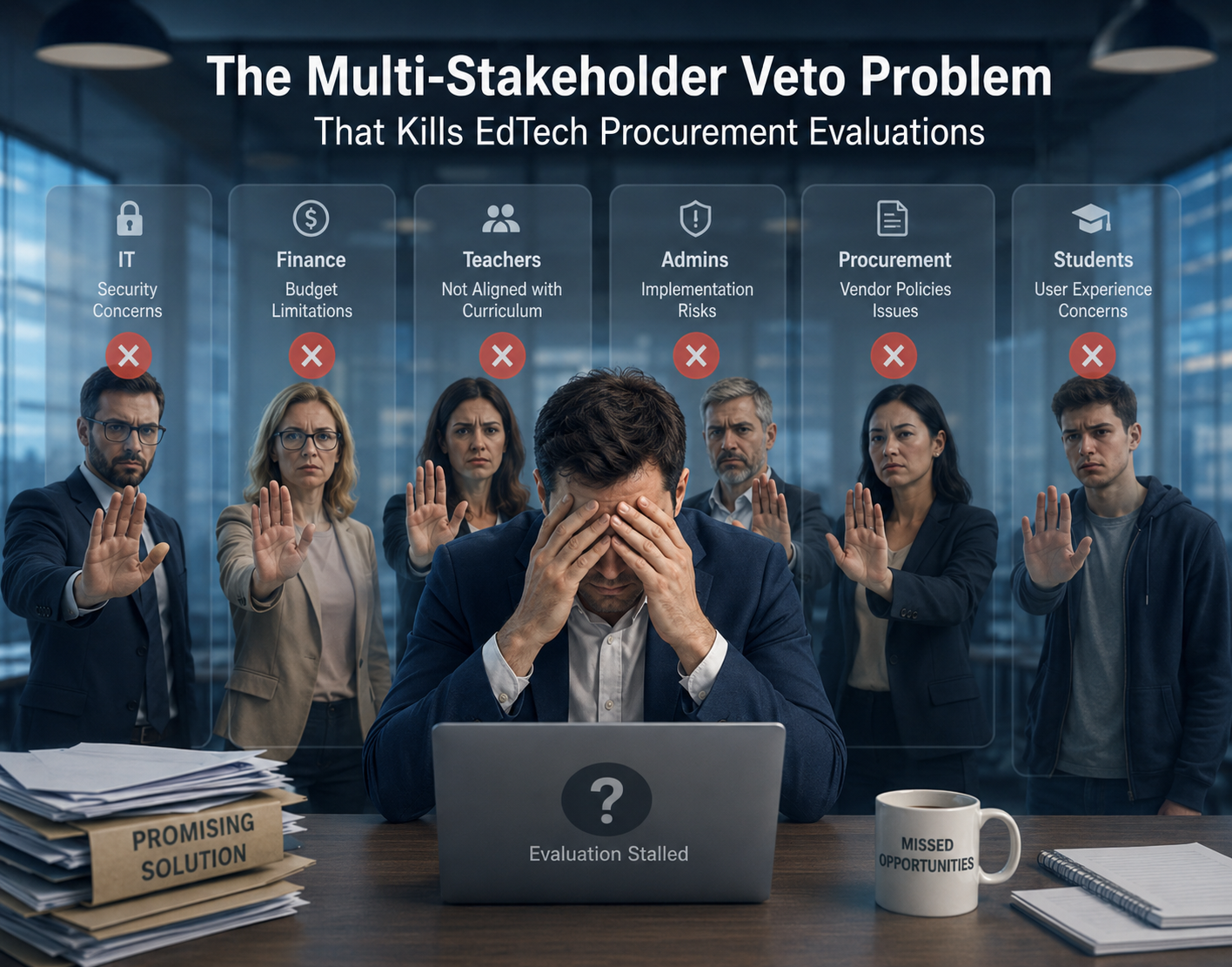
Educational institution procurement is structured differently than enterprise software procurement in any other industry. Enterprise procurement typically has a primary buyer, a CIO or VP of Operations, with authority to advance a decision over individual stakeholder objections. In educational institutions, multiple stakeholders hold genuine veto authority that is not subordinate to any single primary buyer.
Five Different Ways a Deal Can Die
In K-12 district procurement specifically, the curriculum director can veto on pedagogical misalignment, the IT director can veto on data privacy and integration grounds, the CFO can veto on budget grounds, the superintendent can veto on strategic priority, and in many districts the school board must ratify significant purchases, giving board members collective veto authority over any individual administrator's recommendation.
Winning One Approval Doesn't Win the Deal
An EdTech company that wins the curriculum director's enthusiastic recommendation but hasn't addressed the IT director's FERPA questions will have its evaluation terminated at IT review, regardless of pedagogical strength. A company that wins both curriculum and IT approval but hasn't built board-level budget justification will have its contract request declined at ratification instead.
Building Evidence for Every Authority
Enterprise EdTech presentation design for district markets requires building a stakeholder engagement strategy alongside the primary presentation, identifying which stakeholders need what evidence in what format, and building dedicated evidence packages for each evaluation authority before the formal presentation advances to a decision stage where any one of them can end it.
A System, Not a Single Presentation
Working with an EdTech presentation design company that understands the institutional veto structure means working with a team that builds the full stakeholder evidence system, not a single presentation that assumes one decision-maker controls the outcome when in reality four or five different people each hold a piece of it.
How StoryFlo Builds EdTech Presentations That Satisfy Learning Science and Business Returns Simultaneously
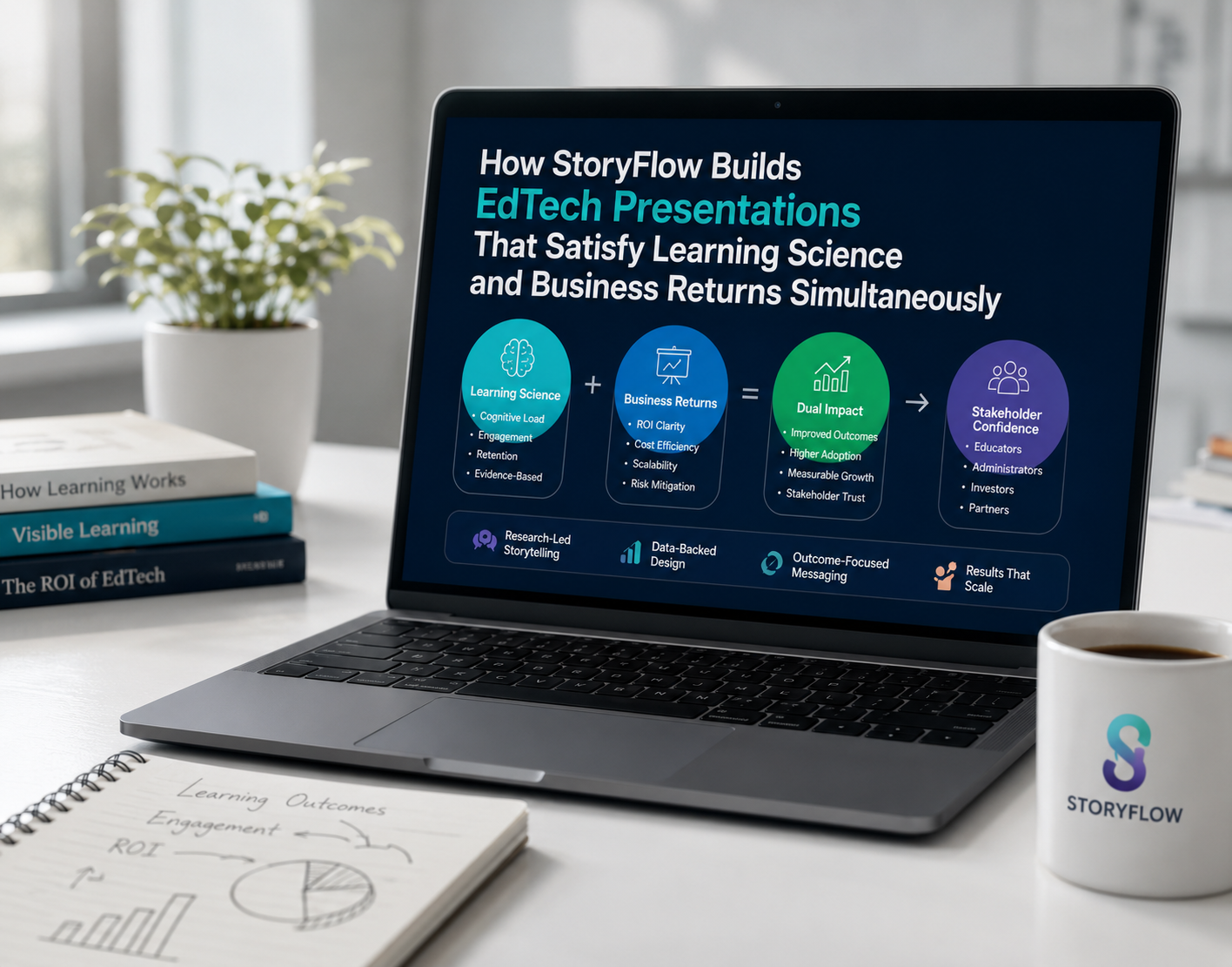
Learning outcomes evidence and business return evidence aren't just different types of information. They're expressed in completely different languages and evaluated through completely different frameworks. A randomized controlled trial showing significant reading gains is compelling to a curriculum director and incomprehensible to a growth equity investor. An NRR of 118% and a 16-month CAC payback is compelling to that investor and irrelevant to an educator evaluating student achievement.
One Shared Evidence Layer, Two Translations
StoryFlo builds a shared evidence layer, the documented learning outcomes, that translates into both frameworks. Student achievement gains translate into institutional value for educators and retention evidence for investors. Teacher adoption rates translate into professional recommendation credibility for educators and NPS and churn prevention evidence for investors. Implementation case studies translate into pedagogical proof and social proof simultaneously.
Sequencing Depends on Who's in the Room
EdTech product presentation design requires a specific sequencing decision. For educator-primary audiences, learning evidence leads and business sustainability follows. For investor-primary audiences, the business model leads and learning evidence follows as the competitive moat and retention driver. For mixed audiences like district administrators evaluating pedagogy and budget simultaneously, learning and business evidence integrate layer by layer instead of running in sequence.
Specific Translation Techniques
StoryFlo converts IES efficacy study results into customer success case study language, converts teacher adoption rates into NPS equivalents for investor presentations, converts student achievement gains into district renewal rate evidence, and converts implementation case study outcomes into dollar-per-learner value calculations that a growth equity investor can actually evaluate on their own terms.
Neither Language Loses Its Integrity
When EdTech companies need custom EdTech presentation design that translates learning science into investor language and business metrics into educator value without losing the integrity of either, StoryFlo's dual standard integration methodology exists specifically for that exact translation challenge, built to hold up under scrutiny from both directions at once.
EdTech Presentation Engagements Built for Your Dual Standard
Every engagement begins with a full learning outcome evidence audit and stakeholder authority mapping, establishing what evidence exists and which stakeholders need what format. Select the engagement level that matches the complexity of your dual audience challenge and the number of stakeholder groups your institutional procurement process requires.
Frequently Asked Questions
We establish learning science differentiation, peer-reviewed efficacy evidence, IES recognition, or WhatWorks Clearinghouse rating, as the primary competitive moat before presenting business metrics. As an EdTech presentation design agency, we know investors evaluate learning outcome evidence as the quality indicator of the entire business model, and strong unit economics alone rarely fund a company without it.
Yes. We build separate audience-specific evidence packages. The curriculum director gets learning efficacy evidence with curriculum alignment documentation. The IT director gets FERPA and COPPA compliance architecture, data residency, and security certification. Both packages share a consistent product narrative but present the evidence each authority requires in the format their professional evaluation demands.
We map the full shared governance review chain before building the presentation. Faculty senate concerns, IT governance requirements, academic affairs alignment standards, and administrative approval criteria. The presentation proactively addresses each stakeholder's primary concern, so when it circulates through the governance chain, each reviewing body finds their criteria already addressed without requiring a follow-up meeting.
Yes. We build a learning transfer evidence foundation, presenting skill application data and business performance improvement metrics that follow training completion, rather than leading with completion rates and satisfaction scores. The evidence comes from your customer data, structured as anonymized case studies showing measurable pre-training to post-training performance change.
Education grants require research rigor, study design quality, comparison group validity, statistical power, alongside implementation feasibility, organizational capacity, and sustainability evidence. We build presentations satisfying both simultaneously, since declining submissions typically show strength in one dimension and weakness in the other, and reviewers notice that imbalance immediately.
Yes. Teacher resistance is a rational response to implementation burden. New features mean learning time and workflow adjustment before any benefit shows. Our EdTech presentation design solutions lead with workflow reduction evidence before showing learning outcome improvement, converting the teacher's primary resistance concern, more work, into the exact evidence they need to commit.
Your Platform Improves Learning. Build the Presentation That Proves It to Every Audience That Decides.
The EdTech companies that win the most consequential district contracts and the most credible investor commitments are not the ones with the largest content libraries. They are the ones whose presentations prove, through research and implementation evidence, that their platform produces real learning. That proof is what an EdTech presentation design agency builds from slide one.